FrostyTech.com Heatsink Reviews and Analysis
> GO < Search
TOP 5 BEST Heat Sinks     SEARCH     News     Reviews    
Follow Frostytech on FacebookFrostytech News RSS FeedFollow frostytech on Twitter
° Reviews and Articles
° Breaking News
° Mfg's Index
° Top 5 Heatsinks
° Top 5 Low Profile   Heatsinks

Top 5 Heatsink Charts

NoFan Computer
   - or - Top 5 Heatsinks?
Quickly find the best Heatsinks for...
° Intel CPUs
° AMD CPUs
° Quiet Running
See all Glacialtech heatsink reviews available [X]
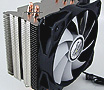
The GX-7 heatsink is constructed around seven 6mm diameter heatpipes, but the number of heatpipes isn't what caught our attention. What's unique about the GX-7 cooler are the two heatpipes stacked on top of the five primary heatpipes. Deepcool's IceEdge 400XT heatsink is a mid-size tower cooler that stands a modest 127mm high and weighs 585 grams. At its heart are four, 6mm diameter copper heatpipes and a 92x100mm stack of dark nickel plated aluminum fins. 

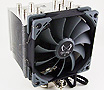
On the test bench today is Glacialtech's Igloo H46 heatsink - a tower style exposed heatpipe base CPU cooler that marks one of the best efforts for this Taiwanese thermal solutions manufacturer to date. The heatsink cools very well on both Intel and AMD platforms, as you'll shortly see. The Scythe Kozuti SCKZT-1000 is a really compact low profile heatsink that conforms to the 1.5U standard and measures just 40mm from tip to toe! That's not a lot of space in which to cram a heatsink capable of handling 150W heat loads... but Scythe manage it. Effizio Series EFZ-92HA3 heatsink is a 
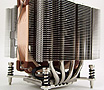
SilenX product. The SilenX EFZ-92HA3 is a compact heatsink that's ideal for Media PCs powered by sub-85W TDP processors. It's built around two 6mm diameter copper heatpipes which are exposed at the base.
GELID GX-7 STACKED HEATPIPE HEATSINK REVIEW DEEPCOOL ICEEDGE 400XT HEATSINK REVIEW GLACIALTECH IGLOO H46 HEATSINK REVIEW SCYTHE KOZUTI SCKZT-1000 1.5U LOW PROFILE HEATSINK REVIEW SILENX EFZ-92HA3 COMPACT TOWER HEATSINK REVIEW
 What's New In Heat Sinks?
Follow Frostytech on Facebook Frostytech News RSS Feed Follow frostytech on Twitter
Sat: 02/04/2012Topic: Cooling / Heatsinks    PermaLink
Japanese cooling expert Scythe is expanding its product portfolio by the new Kaze Master Pro Ace fan controller. The built-in technology is based on the already announced Kaze Master Pro 5.25 fan controller, which now comes with classy aluminum front panel design. Hence allows it to match more pc chassis on the market, especially pc chassis with an aluminum front panel. New Kaze Master Pro Ace fan controller allows users to adjust fan speed of up to fans separately as well as monitoring up to 6 temperature sensors. Adjustments of fan speeds are being made using the 6 potentiometers located in the lower part of the aluminum front panel. Using the other two potentiometers located on the sides, it is possible to choose 2 of the 6 channels to be displayed on the built-in VF-Display (Vacuum Fluorescent Display).
Full Story: 
° Kaze-Master


Fri: 02/03/2012Topic: Cooling / Heatsinks    PermaLink
It's clear from the moment you receive the vast box that Noctua means business with its NH-D14 cooler. The heat sink is comfortably the largest we have tested and the cooler comes with two fans as standard. The question is, does it perform as well as it looks?".
Full Story: 
° itshootout


Fri: 02/03/2012Topic: Cooling / Heatsinks    PermaLink
In this review we will be looking at the new Noctua NF-F12 PWM Fan which features the new Focused Flow technology for better air penetration and overall pressure. The fan features nine major innovations some of which we have seen on competing products with different levels of refinement.
Full Story: 
° ninjalane


Wed: 02/01/2012Topic: Cooling / Heatsinks    PermaLink
"When it comes to reviewing products fans just aren’t something very exciting, unless they’re from our friends at Noctua who always seem to be innovating and improving the designs of their fans. They spend quite a bit of time, effort and money on improving fans. Most people take them for granted really. Today for review I’ve got their newest fan called the NF-F12 PWM which is a 120mm fan with lots of new features and it has a very unique look to it. So read on… "
Full Story: 
° dragonsteelmods


Wed: 02/01/2012Topic: Cooling / Heatsinks    PermaLink
Curiously, I had a discussion with a thermal solutions manufacturer during Computex Taipei, circa-2003/04, about nearly the very same concept that Patent 7282799 - 'Thermal interface with a patterned structure' details. That is, to create very thin, shallow grooves in the base of heatsink to enable the maximal amount of excess thermal interface material to escape from between the heatsink-to-integrated heatspreader contact area.

www.frostytech.com

Physics of course gets the original patent on this, as thermal interface material will naturally do the same thing, given time, heat and clamping force. You can see examples of this after removing a heatsink, provided the base of the heatsink is flat and the clamping forces even. If these conditions exist, you'll see a pattern in the shape of a X going from corner to corner in the remaining thermal goo, with fine fractal patterns sub-dividing the remaining area ad infinitum.

Patent 7282799: Worth the read.

www.frostytech.com


Wed: 02/01/2012Topic: Cooling / Heatsinks    PermaLink
www.frostytech.com

"In this study, the heat transfer performance of various commonly used fin geometries is compared. Realistic, manufacturable geometries are considered for minimizing thermal resistance at moderate laminar air velocities and pressure gradients. These consist of plate fins or pin fins, which can be round, elliptical, or square. The plate fins can be continuous (parallel plates) or staggered. The pin fins can be inline or staggered arrays."

Full Story: 
° imaps.org


Tue: 01/31/2012Topic: Cooling / Heatsinks    PermaLink
www.frostytech.com
"Since a few years, we have developed experimental benches to visualize the flow in the capillary structure of FPHPs closed with transparent plates. Different capillary structures have been studied (grooves with constant or variable widths, crossed grooves, figure 1) for FPHPs made of copper or silicon. Depending on the applications, we have tested FPHPs with different sizes and different evaporator, condenser and adiabatic areas."

Full Story: 
° csc.utt.fr


Tue: 01/31/2012Topic: Cooling / Heatsinks    PermaLink
Just go here -
www.frostytech.com
- and click on the 'Like' button to follow Frostytech on Facebook.

Full Story: 
° Facebook


Tue: 01/31/2012Topic: Cooling / Heatsinks    PermaLink
Some interesting articles on Electronics-cooling relating to heatsinks and thermodynamics - No. 9 was my favourite of last year. Give them a read and educate yourself.

"

1. THE SEEBECK COEFFICIENT
Clemens J. M. Lasance (2006)

This article addresses the Seebeck coefficient, a property that determines the performance of thermocouples and Peltier elements. Basically, the Seebeck coefficient is related to the fact that electrons are both carriers of electricity and heat. If a temperature gradient exists over a piece of electrically conductive wire, there is a net diffusion of electrons from the hot end toward the cold end, thereby creating an opposing electric field. In (quasi) equilibrium this field causes a voltage over the wire, the so-called Seebeck voltage.

2. HEAT PIPES FOR ELECTRONICSCOOLING APPLICATIONS
Scott D. Garner, PE (1996)

Heat pipes have been commercially available since the mid 1960s. Only in the past few years, however, has the electronics industry embraced heat pipes as reliable, cost-effective solutions for high-end cooling applications. The purpose of this article is to explain basic heat pipe operation, review key heat pipe design issues, and to discuss current heat pipe electronic cooling applications.

3. NOTES ON USING THERMOCOUPLES
Robert J. Moffat (1997)

This article discusses thermocouples, the most widely used temperature sensor in test and development work. Accurate temperature measurements can be made at low cost with shop-built probes and ordinary low-level voltmeters.

4. ADVANCES IN HIGH-PERFORMANCECOOLING FOR ELECTRONICS
Clemens J. M. Lasance and Robert E. Simons (2005)

The need for new cooling techniques is driven by the continuing increases in power dissipation of electronic parts and systems. In many instances standard techniques cannot achieve the required cooling performance due to physical limitations in heat transfer capabilities. These limitations are principally related to the limited thermal conductivity of air for convection and copper for conduction.

5. SIMPLIFIED FORMULA FOR ESTIMATINGNATURAL CONVECTION HEAT TRANSFERCOEFFICIENT ON A FLAT PLATE
Robert E. Simons (2001)

Natural convection cooling combined with radiation is what results when a fan is not used in the cooling design to move air. Instead, movement of the air is induced by density differences resulting from the heat dissipated by the electronic components. An obvious advantage of natural convection, or "free" convection as it is sometimes called, is that the expense of incorporating a fan is avoided. Of course the penalty associated with this method of cooling is lower heat transfer coefficients.

6. ALL YOU NEED TO KNOW ABOUT FANS
Mike Turner (1996)

Fans can be thought of as low pressure air pumps that utilize power from a motor to output a volumetric flow of air at a given pressure. A propeller converts torque from the motor to increase static pressure across the fan rotor and to increase the kinetic energy of the air particles. The motors are typically permanent split capacitor AC induction motors or brushless DC motors. This article looks at this system in more detail.

7. IN THE DATA CENTER, POWER ANDCOOLING COSTS MORE THAN THE ITEQUIPMENT IT SUPPORTS
Christian L. Belady, P.E. (2007)

Historically, the cost of energy and the cost of the data center power and cooling infrastructure have not been on the radar for most Chief Financial Officers (CFO) and Chief Information Officers (CIO) and have not been considered in TCO (Total Cost of Ownership) models. As a result, almost all of the focus has been on driving down the cost of IT equipment in the data center. This was a reasonable assumption during the 90’s when server power and energy costs were substantially lower. However, power density has been increasing at an alarming rate. During this same period of rapid power growth, server costs have stayed virtually flat and raw performance has increased substantially.

8. ESTIMATING PARALLEL PLATE-FINHEAT SINK THERMAL RESISTANCE
Robert E. Simons (2003)

The trend of increasing electronic module power is making it more and more difficult to cool electronic packages with air. As a result there are an increasing number of applications that require the use of forced convection air-cooled heat sinks to control module temperature.

9. THERMAL CONDUCTIVITY OF SOLDERS
Jim Wilson (2006)

Soldering has been a primary method of establishing mechanical and electrical connections in electronics for many years and will likely be used in this fashion in the future. While there are several physical properties and characteristics of solders that are of interest to the electronics community at large, one of the most significant physical properties to a thermal engineer is thermal conductivity.

10. HOW TO SELECT A HEAT SINK
Seri Lee (1995)

With the increase in heat dissipation from microelectronics devices and the reduction in overall form factors, thermal management becomes a more important element of electronic product design.

11. AN INTRODUCTION TOTHERMOELECTRIC COOLERS
Sara Godfrey (1996)

Thermoelectric coolers are solid state heat pumps used in applications where temperature stabilization, temperature cycling, or cooling below ambient are required. There are many products using thermoelectric coolers. This article discusses the theory behind the thermoelectric cooler, along with the thermal and electrical parameters involved.

"


Tue: 01/31/2012Topic: Cooling / Heatsinks    PermaLink
Scythe Co. Ltd. extends the popular Gentle Typhoon fan series by three powerful high RPM models. The new Gentle Typhoon High RPM fans are available with 3.000, 4.250 and 5.400 rpm. These high fan speeds generate an incredible airflow of 141, 197 and 255 m³ per hour (83.0 / 116.5 / 150.1 CFM). In direct comparison to fans with similar specs, the Gentle Typhoon High RPM series scores with a significant lower noise. Like the normal GT models, a perfectly balanced Nidec Servo bearing is used, ensuring an average MTBF of 100.000 hours. The reliable motor operates with an almost fluctuation-free rotational torque. Vibrations transferred from the motor to the venturi (fan case) are reduced to a minimum.

www.frostytech.com

Full Story: 
° gentle


Tue: 01/31/2012Topic: Cooling / Heatsinks    PermaLink
ARCTIC is proud to release its new VGA cooler - the Accelero Xtreme 7970, which is compatible with the world’s first 28nm GPUs. This VGA cooler is mainly designed to fit the AMD 7900/7800 series graphic cards. It is equipped with a 92 mm ultra-quiet PWM fan and five heatpipes which provide an optimal cooling capacity of up to 300 Watts with inaudible operation.
Full Story: 
° benchmarkemail


Mon: 01/30/2012Topic: Cooling / Heatsinks    PermaLink
Japanese cooling expert Scythe has today announced a new Screw Kit for upgrades to socket LGA2011. Thanks to this new Scythe Screw Kit for Intel LGA 2011 users are able to upgrade new as well as older Scythe CPU Coolers to achieve compatibility to the recently announced enthusiast platform based on socket LGA2011. It is possible to use the new Screw Kit with the CPU Coolers Mugen 3, Mine 2, Ninja 3, Susanoo, Mugen 2 Rev.B and Big Shuriken 2 to upgrade and establish compatibility. Required screws, wrench and manual are contained in the package of the Screw Kit. Mentioned CPU Coolers are usually mounted with a Scythe backplate designed for various sockets. Socket LGA2011 mainboards are already equipped with an own pre-mounted backplate which is firmly connected to the socket. Scythe Screw Kit for Intel LGA 2011 is utilizing this backplate and achieves a solid as well safe mounting between socket LGA2011 and the Scythe CPU Cooler. Installation still requires the Metal Assembly Clips for socket LGA775, 1155, 1156, 1366 which are delivered with the mentioned CPU Coolers.
Full Story: 
° accessory


Fri: 01/27/2012Topic: Cooling / Heatsinks    PermaLink
"To sum it all up, Cooler Master's new Hyper 212 Evo CPU cooler has great performance, yet leaves a relatively small acoustic footprint. The included mounting solution is very robust, if a bit fussy to install, and Cooler Master includes an extra pair of fan clips should the user wish to add another fan."
Full Story: 
° tweaknews


Fri: 01/27/2012Topic: Cooling / Heatsinks    PermaLink
"The Prolimatech Lynx is a smaller version of the Panther CPU cooler that we tested recently. It has a small, lightweight tower heatsink with three heatpipes and comes with one 120 mm fan."
Full Story: 
° Prolimatech


Fri: 01/27/2012Topic: Cooling / Heatsinks    PermaLink
www.frostytech.com
On the test bench today is Glacialtech's Igloo H58 heatsink - a tower style exposed heatpipe base CPU cooler that marks one of the best efforts by this Taiwan-based thermal solutions manufacturer. The heatsink cools very well on both Intel and AMD platforms as you'll shortly see.

The aluminum fins on this tower heatsink are 0.2mm thick, allowing air to easily pass through the fin stack and consequently keep noise levels in check. The single 140mm PWM fan on the Igloo H58 heatsink rocks out at 1400 RPM full blast, just 700 RPM when dialed back to its most conservative speed. Noise levels flutter between 46.4-31.0 dBA according to Frostytech's real world sound measurements - ie. it's nice and quiet.

Full Story: 
° frostytech


Fri: 01/27/2012Topic: Cooling / Heatsinks    PermaLink
"Cooler Master's GeminII range offer top down cooling designs, with the S524 the newest edition. Compatible with 120mm and 140mm fans it can offer an upgrade for your processor cooling - and your whole system."
Full Story: 
° rage3d


Thu: 01/26/2012Topic: Cooling / Heatsinks    PermaLink
The evolutionary Hyper 212 model now boasts new base with improved heatpipes direct-touch technology and a new fan. The cooler has also become a little pricier. Let’s find out how successful these improvements turned out to be.
Full Story: 
° xbitlabs


Thu: 01/26/2012Topic: Hard Drives    PermaLink
Can a well-known cooling product manufacturer roll out a good SSD? Yes, he can, because the second generation SandForce platform paved a very short route to the SSD market for those interested.
Full Story: 
° xbitlabs


Wed: 01/25/2012Topic: Cooling / Heatsinks    PermaLink
The Cooler Master Hyper 412 PWM takes the idea of direct contact a step further by using what they term “C.D.C.” Heat Pipes. “C.D.C.” in the Cooler Master Hyper 412 PWM stands for “Continuous Direct Contact”, and refers to four reshaped heat pipes which allow them to be placed with no gaps between. The heat pipes transform to a half circle in the contact area, and laid side by side allow for a smooth, even coverage on the CPU’s hot spots, all with direct heat pipe contact. In addition, the Hyper 412 PWM offers airflow refinements using a 120mm fan with variable speeds from 600-2000rpm controlled by PWM, and is dual fan capable with hardware for the second fan included."
Full Story: 
° hitechlegion


Wed: 01/25/2012Topic: Cooling / Heatsinks    PermaLink
"The Cooler Master Hyper 212 EVO is a mid-priced tower cooler for budget minded enthusiasts looking for a solid performing and good looking replacement for their stock cooler. Using Intel's X58 Core i7 platform as a heat load, we test it in single and dual fan configuration."
Full Story: 
° rage3d


 Next Page »

Resources
° Got Feedback?
° Mk.II Test Platform
° Where To Buy?
° Manufacturer Index
° Industry Dir.
° Cooling Projects

Auras Shagon AHC-118 Lower Noise Heatsink Review

Zalman CNPS11X Extreme Heatsink Review

Zalman CNPS12X Lower Noise Heatsink Review

Hanjung Grip100-S and Grip110-U2 Notebook Cooling Pads Review

Fostering Better Heatsinks - Does Zalman really use Composite Heatpipes?

Xigmatek Prime SD1484 Heatsink Review
...More Articles >>

Tech Polls
Thermal Compound Testing
How much would you pay to read a comprehensive test report of various CPU Thermal Compound pastes?
Nothing
$2 - $4
$5 - $10
Number of votes: 3307

Websites you may also like:
Silent PC Review
Cooling-Masters
Matbe.com

Google Search Frostytech
Time stamped: 9:43AM, 02.04.2012


Member of The Rydium Network

Find a Heatsink / RSS Feeds
Latest Heatsink Reviews
Top 5 Heatsinks Tested
FrostyTech News RSS Feed
FrostyTech Reviews RSS Feed


FrostyTech.com Info
Feedback
Contact Us / Heatsink Submissions
Submit News
Legal


© Copyright 1999-2012 www.frostytech.com. All Rights Reserved. Privacy policy and Terms of Use
Images are © FrostyTech.com and may not be reproduced without express written permission.