TOP 5 Heat Sinks TOP 5 Low Profile Heat Sinks TOP 5 Liquid Coolers
Heatsinks by Brand / Mfgr Reviews + Articless Advanced Search
|
TOP 5 Heat Sinks TOP 5 Low Profile Heat Sinks TOP 5 Liquid Coolers Heatsinks by Brand / Mfgr Reviews + Articless Advanced Search |
Essentially, a 5mm thick copper baseplate is bolted to the bottom of an Akachi heatpipe whose only purpose is to absorb heat from the CPU and transfer it to a multitude of aluminum fins over its "U" shaped race track of about 385mm in length. The Akachi heatpipe, or Heatlane heatpipe as it maker, TS Heatronics, calls it, increases the total cooling surface area with the aide of dozens of aluminum cooling fins. Traditional vs Akachi Heatpipes Traditional heatpipes are really neat devices; as heat energy enters into the pipe, water under a vacuum inside the tube is converted into vapour (water boils at a lower temperature when there is less atmospheric pressure). That water vapour is used to transfer the heat it has absorbed to the other end of the heatpipe. As the vapour reaches the colder side of the tube it condenses, and returns back to liquid form. As it does so, the energy which caused the water to turn to vapour is dumped into the surrounding metal of the heatpipe, which impart transfers it to cooling fins. A physical property know as capillary action then takes hold and draws the freshly condensed liquid back along an internal wick structure to the hot side of the heatpipe where the entire process repeats.
The HFC-130a working fluid, once heated, circulates through a "meandering capillary tube" that is formed from about 30 individual 1mm x 1mm channels within the 2mm thick x 60mm wide extruded aluminum pipe structure. If you're a little unsure of what that describes, just look at the edge of a corrugated cardboard box where you see all those little folds, and visualize pretty much the same thing in aluminum.
Invented by Hisateru Akachi who called the technology "self-excited oscillation heatpipe", the Akachi pipe works something like this... (Note: The English documentation is a bit vague, so we may be off on some of the finer points of the technology.)
TS Heatronics have a quick video of the process in motion on this page, taken with an X-ray machine so you can actually see the little vapour bubbles and working fluid racing through the aluminum Heatlane pipes.
|
 |
|
| |||||||||||||||||||||||||
|
Find a Heatsink . Latest Heatsink Reviews . Top 5 Heatsinks Tested . Top 5 Low Profile Heatsinks . Top 5 Liquid Coolers . Heatsinks by Mfgr / Brand |
Social Media |
FrostyTech.com Info . Feedback . Contact Us / Heatsink Submissions . Submit News . Privacy Policy |
 | |
© Copyright 1999-2025 www.frostytech.com All Rights Reserved. Privacy policy and Terms of Use Images © FrostyTech.com and may not be reproduced without express written permission. Current students and faculty of accredited Universities may use Frostytech images in research papers and thesis, provided each image is attributed. | ||||

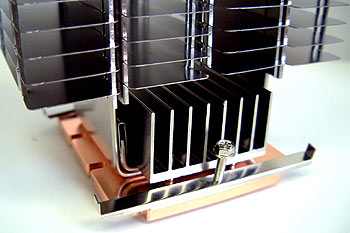 The Scythe NCU-2000 looks like some massive industrial cooler plucked out of a radar system, but
is actually built around some pretty common cooling technologies we've seen before in
PC's.
The Scythe NCU-2000 looks like some massive industrial cooler plucked out of a radar system, but
is actually built around some pretty common cooling technologies we've seen before in
PC's.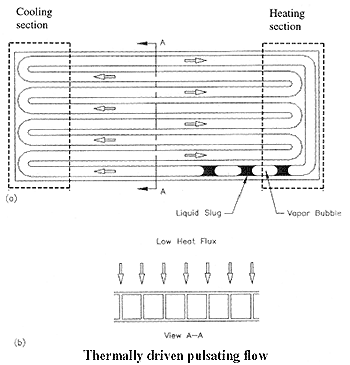 What goes on inside the Akachi
heatpipe is similar to this process, but the technology has a few distinct differences. First of all,
where a standard copper heatpipe uses water as a working fluid, this Akachi pipe
uses a slightly more exotic chemical; hydroflurocarbon-134a (HFC-134A). The manufacturer has
included a full page of warnings about the proper use of the NCU-2000 with
regards to the HFC-130a, and we recommend you read through them at least once so
you don't accidentally maim
yourself.
What goes on inside the Akachi
heatpipe is similar to this process, but the technology has a few distinct differences. First of all,
where a standard copper heatpipe uses water as a working fluid, this Akachi pipe
uses a slightly more exotic chemical; hydroflurocarbon-134a (HFC-134A). The manufacturer has
included a full page of warnings about the proper use of the NCU-2000 with
regards to the HFC-130a, and we recommend you read through them at least once so
you don't accidentally maim
yourself.