TOP 5 Heat Sinks TOP 5 Low Profile Heat Sinks TOP 5 Liquid Coolers
Heatsinks by Brand / Mfgr Reviews + Articless Advanced Search
|
TOP 5 Heat Sinks TOP 5 Low Profile Heat Sinks TOP 5 Liquid Coolers Heatsinks by Brand / Mfgr Reviews + Articless Advanced Search |
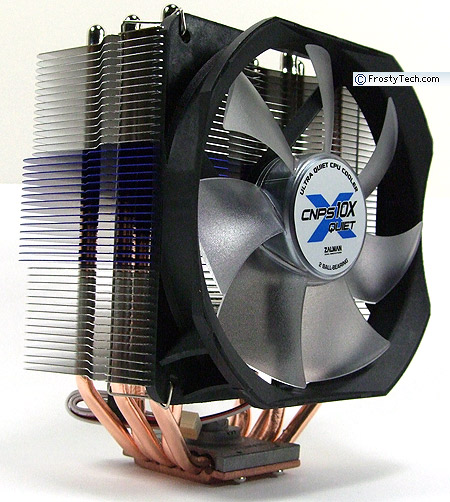
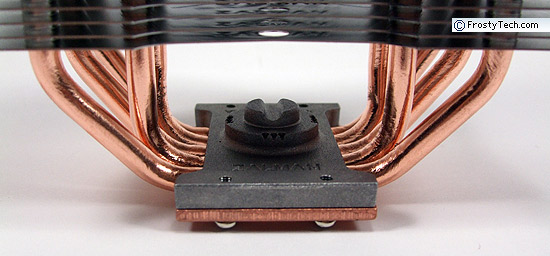
Zalman's CNPS10X Quiet heatsink is equipped with a 120mm fan that ranges in speed from 1400RPM to 700RPM, which in real world terms means that noise levels are moderate to whisper quiet. As a low noise heatsink the CNPS10X Quiet maintains good thermal levels on Frosty's AMD/Intel test platforms, and at full tilt it qualifies as a performance heatsink. The Korean-made CNPS10X Quiet heatsink stands 159mm high, weighs in at 750 grams and supports Intel socket 775/1156/1366 and AMD 754/939/940/AM2/AM2+/AM3 processors. Constructed from a die-cast copper baseplate soldered to five 6mm diameter copper heatpipes that pass through 110mm worth of raw aluminum fins, the standard tower heatsink format once again shows us why so many heatsink have gone this route. On the whole the CNPS10X Quiet is a simpler heatsink than Zalman's CNPS10X Extreme, though no less effective. It's retention brackets are easy to install, and the CNPS10X Quiet ships with Zalman's manual FanMate2 fan speed controller for those that like to get all 1984 on their heatsinks. At 159mm tall and 135mm wide, the Zalman CNPS10X Quiet demands a good 68mm clearance from the center of the CPU socket out, as the 37mm clearance below the bottom fin may not pass over tall memory DIMMs on certain motherboards. On Intel platforms the mounting hardware will allow it to be installed in any direction, AMD users are limited by the orientation of the AMD heatsink retention cage.
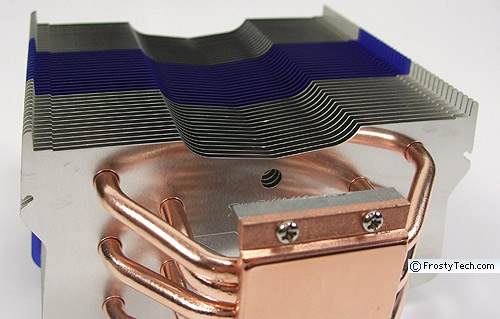
Thirty raw aluminum fins are inter spaced with fifteen blue anodized aluminum fins that extend slightly further on the sides and back of the heatsink. Like many tower heatsinks, Zalman have conspicuously staggered the heatpipes where they pass through the cooling fins and positioned them towards the region with the highest airflow.
Mounting Method and Hardware
Zalman's
CNPS10X Quiet heatsink can be installed on Intel socket 775/1156/1366 processors, and the full
range of AMD chips from socket 754/939/940/AM2/AM2+ through to socket
AM3. Every major CPU variation is covered by this one heatsink, good for those
planning a transition to Core i5/Phenom II in the coming months.
Installation is straightforward, although there are those pesky clearance issues
to be aware of. Generally speaking, the CNPS10X Quiet will fit any modern motherboard,
but requires about 70mm space from the center of the CPU above and below, back and front. Zalman note that at least 165mm space above the CPU itself is necessary, although the heatsink Frostytech tested measured only 159mm tall.
The AMD
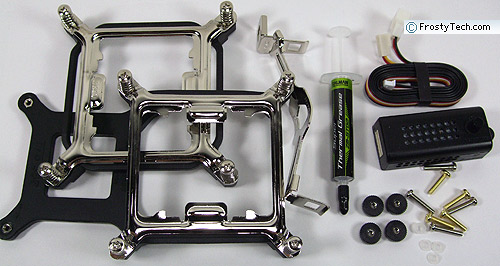
mounting clip makes use of the stock AMD heatsink retention frame. A stainless steel clip fits over the central hub on the heatsink's base cap
and locks onto the retention tabs on AMD motherboards. The heatsink should generally be
oriented with airflow exhausting towards the rear of the case if that's possible. If
not, the next best position is the fan exhausting up towards the
power supply.
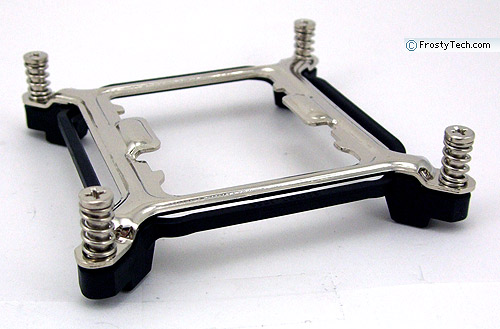
Intel socket 1366 and 775/1156 processors make use of a special plastic frame which is attached onto the motherboard prior to installation
of the Zalman CNPS10X Quiet heatsink. Access to the back of the board is necessary to apply
a rear support plate, or interchangeably the mounting screws/nets. Thereafter a steel bracket locks onto the base of the CNPS10X Quiet heatsink and applies correct clamping force care
of four spring-tensioned machine screws.
This heatsink will be tested on FrostyTech's Intel LGA775 and AMD version
of the Mk.II synthetic thermal temperature test platform, and compared
against a couple hundred reference heatsinks. The whole test methodology is outlined in detail here if you'd like to know what equipment is
used, and the parameters under which the tests are conducted.
|
 |
|
| |||||||||||||||||||||||||||||||||||||||||
|
Find a Heatsink . Latest Heatsink Reviews . Top 5 Heatsinks Tested . Top 5 Low Profile Heatsinks . Top 5 Liquid Coolers . Heatsinks by Mfgr / Brand |
Social Media |
FrostyTech.com Info . Feedback . Contact Us / Heatsink Submissions . Submit News . Privacy Policy |
 | |
© Copyright 1999-2025 www.frostytech.com All Rights Reserved. Privacy policy and Terms of Use Images © FrostyTech.com and may not be reproduced without express written permission. Current students and faculty of accredited Universities may use Frostytech images in research papers and thesis, provided each image is attributed. | ||||