TOP 5 Heat Sinks TOP 5 Low Profile Heat Sinks TOP 5 Liquid Coolers
Heatsinks by Brand / Mfgr Reviews + Articless Advanced Search
|
TOP 5 Heat Sinks TOP 5 Low Profile Heat Sinks TOP 5 Liquid Coolers Heatsinks by Brand / Mfgr Reviews + Articless Advanced Search |
The Noctua NH-U9B is a refined take on the previously successful NH-U9 heatsink. This time around, Noctua nickel plate all copper surfaces and bundle in the super quiet NF-B9 fan - and it's not your average vaneaxial fan either. The NF-B9 is a flesh-toned fan with three key innovations; SSO bearings, vortex-control notches, and textured leading impeller surfaces. That translates into a fan which is very quiet at a speed of 1600RPM, and with two in-line resistors its rotational speed can be further reduced without impacting temperatures too dramatically. That's all well and good, but you probably want to know if Noctua's NH-U9B is one of the few heatsinks able to break away from the "low noise handicap" and perform more like a performance cooler? In other words, is it good? Noctua's NH-U9B heatsink stands 120mm tall, 96mm across and can accommodate one or two 92mm fans. In Frostytech's tests, a single 92mm fan more than sufficient for the job. Noctua ship the cooler with a single NF-B9 92mm fan, mounted to the heatsink with wire clips. All the necessary CPU mounting hardware is included for Intel LGA775 and AMD 939/AM2 processors. The nickel-plated aluminum cooling fins are connected by four nickel-plated copper heat pipes to a nickel-plated copper base, and the total weight is a moderate 460 grams.
Compared to the previous model of the same name, the Noctua NH-U9B heatsink incorporates a few cosmetic improvements. Namely, the heatpipes and copper base in this model are all nickel plated, and every metal joint is soldered. Soldering decrease thermal joint resistance between the fins and heatpipes, or heatpipes and base.
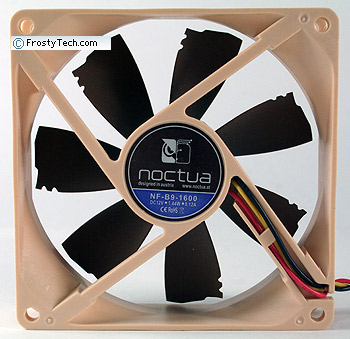
One of the main selling points of Noctua's heatsinks are the specialized low noise fans used. The Noctua NF-B9 fan incorporates double notches (see below) on the trailing edges of each impeller called vortex-control notches. These break up trailing edge vortices into several smaller vortices which ultimately cause noise to be spread over a wider range of frequencies and less perceptible. Special SSO bearings are used in the motor housing. It also helps that the NF-B9 92mm fan rotates at a leisurely 1600RPM. To further reduce noise from the heatsink, Noctua provide two in-line resistors which drop in between the fan and motherboard. A black
colour-coded resistor reduces fan speed to about 1300RPM, and another (blue) to
about 1000RPM. The blue connector makes the Noctua NH-U9B heatsink
operate in its most quiet setting, about 32 dBA in our real world
tests.
Installation
Hardware Noctua's NH-U9B heatsink is compatible with Intel socket
775 and AMD socket 754/939/940/AM2/AM2+ processors. A multi-language manual provides guidance, and a special
screwdriver is even included. As always, we'd recommend orienting the fan
towards the rear of the PC case.
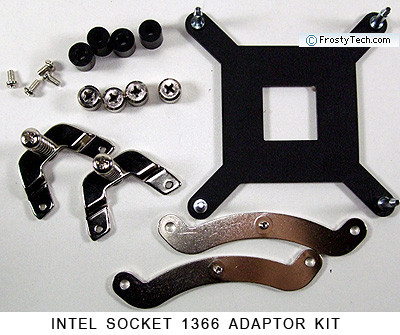
One of the nice aspects of this heatsink is that Noctua has released a new mounting kit to make it compatible with Intel's Core i7 socket 1366 processor! The Noctua SecuFirm2 mounting kit works with any Noctua CPU heatsink going back to 2005, and best of all it's available for free from Noctua's website. Socket 1366
processors use slightly wider spaced motherboard mounting holes for
heatsinks to attach to - 80mm vs. 72mm for LGA775 chips - so existing socket 775
brackets are not compatible with this new Intel CPU in spite of the fact the
heatsink is probably still well suited.
Base Finish and Flatness
Flipping
a heatsink over to inspect the business end is often a simple indicator of
overall cooler quality. More practically speaking, a heatsink is in many ways
only as effective as the contact it makes with the processor - the flatter and
smoother the better. Base finish is one of the criteria that Frostytech measure
in the course of evaluating heatsinks, and it involves two distinct aspects.
Surface Finish is the first; this is calculated with the aid of Surface
Roughness Comparator that has a cross section of common machine surface finishes
and their numerical surface roughness equivalents in microinches. The second is
Surface Flatness. This is tested with an engineers straight edge or proven flat
surface, in two axis. The
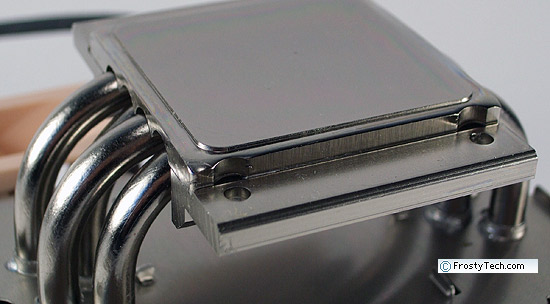
Noctua NH-U9B heatsink has a machined nickel-plated copper base with a surface
roughness of approximately ~48 microinches. The manufacturer has purposefully
given it a ridged texture. The base is very slightly concave when examined with
an engineers straight edge. Screw holes at each corner allow the mounting
brackets to be attached. FrostyTech's Test Methodologies are outlined in detail here if you care to know what equipment is
used, and the parameters under which the tests are conducted. Now let's move
forward and take a closer look at this heatsink, its acoustic characteristics,
and of course its performance in the thermal
tests!
|
 |
|
| |||||||||||||||||||||||||||||||||||||||||||||
|
Find a Heatsink . Latest Heatsink Reviews . Top 5 Heatsinks Tested . Top 5 Low Profile Heatsinks . Top 5 Liquid Coolers . Heatsinks by Mfgr / Brand |
Social Media |
FrostyTech.com Info . Feedback . Contact Us / Heatsink Submissions . Submit News . Privacy Policy |
 | |
© Copyright 1999-2025 www.frostytech.com All Rights Reserved. Privacy policy and Terms of Use Images © FrostyTech.com and may not be reproduced without express written permission. Current students and faculty of accredited Universities may use Frostytech images in research papers and thesis, provided each image is attributed. | ||||

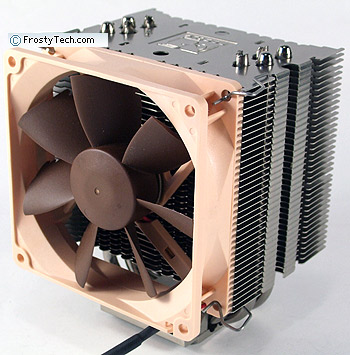

 The Noctua NH-U9B accommodates 92mm and 80mm fans, and comes
with an extra set of wire clips so two fans can be mounted.
The Noctua NH-U9B accommodates 92mm and 80mm fans, and comes
with an extra set of wire clips so two fans can be mounted.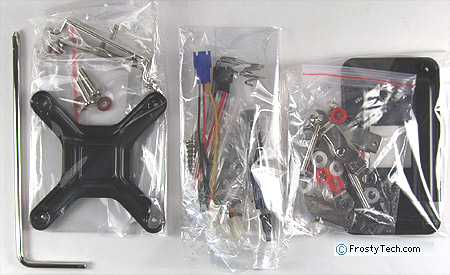 Small metal tabs are
attached to the heatsink base, a backplate positioned behind the motherboard,
then everything fixed in place with spring-tensioned screws. The installation
process is straight forward, but you may have to remove the motherboard from the
computer case which is never fun.
Small metal tabs are
attached to the heatsink base, a backplate positioned behind the motherboard,
then everything fixed in place with spring-tensioned screws. The installation
process is straight forward, but you may have to remove the motherboard from the
computer case which is never fun.