TOP 5 Heat Sinks TOP 5 Low Profile Heat Sinks TOP 5 Liquid Coolers
Heatsinks by Brand / Mfgr Reviews + Articless Advanced Search
|
TOP 5 Heat Sinks TOP 5 Low Profile Heat Sinks TOP 5 Liquid Coolers Heatsinks by Brand / Mfgr Reviews + Articless Advanced Search |
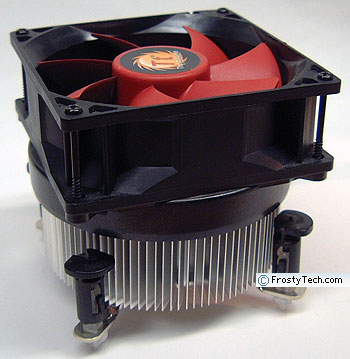
Thermaltake's Jungle 512 socket
775 heatsink looks like it
packs a pretty heavy punch.... but does it really? It's monsterous 92mm
PWM fan draws upwards of 1.0Amp at full speed, and its red fan blades spin
with enough force to take a big chunk out of careless fingers
too. Below the big fan is a circular
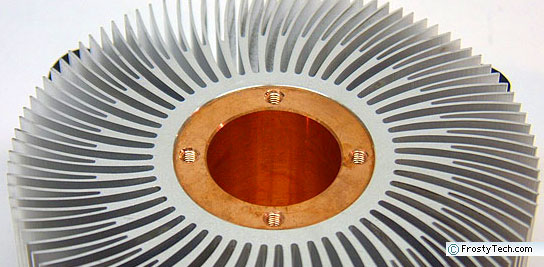
array of bifurcated aluminum fins, and at the Jungle 512's heart a large
copper slug; all fairly standard stuff for an Intel socket 775 heatsink.
In fact
the Thermaltake Jungle 512 is one of many heatsinks based almost entirely
on Intel's reference RCBFH-3 heatsink design. After developing the Radial
Curved Bifurcated Fin Heatsink (RCBFH-3) thermal solution for
itself, the design has flourished. Almost every single heatsink manufacturer has
at least one cooler based upon it.
The Intel
'Prescott FMB2' compliant Thermaltake Jungle 512 heatsink is equipped with a
32x92x92mm 4-pin PWM fan that rotates at between 2300 and 3600RPM. When
installed on a PWM fan compatible socket 775 motherboard, this finger
chopping fan scales its speed to meet the immediate thermal demands of
the processor, without creating too much unnecessary noise. We tested the Jungle
512 with a standard 3-pin fan power supply, and in that instance the
fan defaults to its lower speed of 2300RPM. That's good enough for adequate
cooling, but not any better than the stock Intel
Pentium D heatsink can dish
out.
The 560g
Thermaltake Jungle 512 heatsink
installs onto any socket 775 motherboard via Intel's plastic push-to-click,
turn-to-release retention clips. No tools are needed.
The copper transfers heat energy from the CPU, and increases the total surface area of the heat source before transferring the heat energy to the 40mm high aluminum component. As you know, surface area is key to achieving an efficient thermal solution. The more cool air you can pass over a surface of a given size, the more heat you can remove into the surrounding environment. This is where the radially curved bifurcated aluminum fins come into play; compared to a standard fin they have about 1.5x the surface area. Bifurcated simply means "to divide or fork into two branches," and that is exactly what the fins look like.
FrostyTech's heatsink test methodology is outlined in detail here if you care to know what equipment is used, and the parameters under which the tests are conducted. Now let's move forward and take a closer look at this heatsink, its acoustic characteristics, and of course it performance in the thermal tests!
|
 |
|
| |||||||||||||||||||||||||||||||||||||||||
|
Find a Heatsink . Latest Heatsink Reviews . Top 5 Heatsinks Tested . Top 5 Low Profile Heatsinks . Top 5 Liquid Coolers . Heatsinks by Mfgr / Brand |
Social Media |
FrostyTech.com Info . Feedback . Contact Us / Heatsink Submissions . Submit News . Privacy Policy |
 | |
© Copyright 1999-2025 www.frostytech.com All Rights Reserved. Privacy policy and Terms of Use Images © FrostyTech.com and may not be reproduced without express written permission. Current students and faculty of accredited Universities may use Frostytech images in research papers and thesis, provided each image is attributed. | ||||