TOP 5 Heat Sinks TOP 5 Low Profile Heat Sinks TOP 5 Liquid Coolers
Heatsinks by Brand / Mfgr Reviews + Articless Advanced Search
|
TOP 5 Heat Sinks TOP 5 Low Profile Heat Sinks TOP 5 Liquid Coolers Heatsinks by Brand / Mfgr Reviews + Articless Advanced Search |
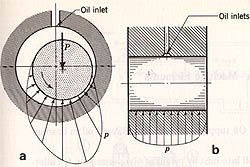
The next most common bearing system used in computing peripherals is the sleeve bearing. These bearings are made from materials like bronze, beryllium copper and similarly hard metals that are typically pressed into porous forms by powder metallurgy. The bearings are generally thick cylinders impregnated with oil, with a highly toleranced internal shaft space. The oil is carried within the sleeve by interconnecting pores which can account for up to 35% of the volume. The sleeve bearing operates on the principle that the rod fitting within the shaft rests upon a very thin layer of lubricant as it rotates which is drawn up by capillary action. In an ideal situation the rod wouldn't make any contact with the sleeve and operate essentially silently. Without that thin layer of fluid between the rotating shaft and the sleeve, the bearing material will wear away from the friction.
Known sleeve bearing problems. When sleeve bearings fail, one of three things typically happens. Almost all failures will occur because of issues with the lubrication. Failure one, worn bearing- This occurs when the lubrication is insufficient or the rotating component too unbalanced,. The rod begins to wear away the sleeve material to a point when the cylindrical space is no longer round. The rod will begin to vibrate producing an audible noise as it rotates. In instances such as this there is nothing that can be done, but to replace the bearing or more typically the entire fan. Failure two, reduced fan speed - A situation can sometimes develop where the lubricant partially evaporates, or becomes more viscous then its operational tolerances will allow. It then resists the magnetic forces rotating the fan blades causing the entire assembly to rotate at a lower then normal RPM. The results of this type of soft failure can be serious if the fan is cooling an essential device like a power supply or CPU. Failure three - Complete failure. Occurs when there is an absence of lubricant, or when highly viscous lubricant overcomes the rotational force from the fans' motor. In these cases the fan will not rotate at all, and devices which need cooling may overheat. This is one of the more common failures among power supply fans because of the continual amount of dust they suck in and their elevated operating temperatures. This type of failure can also occur when improper lubricants are used which become highly viscous through age or as a reaction to operational temperatures.
|
 |
|
| |||||||||||||||||||||||||||
|
Find a Heatsink . Latest Heatsink Reviews . Top 5 Heatsinks Tested . Top 5 Low Profile Heatsinks . Top 5 Liquid Coolers . Heatsinks by Mfgr / Brand |
Social Media |
FrostyTech.com Info . Feedback . Contact Us / Heatsink Submissions . Submit News . Privacy Policy |
 | |
© Copyright 1999-2023 www.frostytech.com All Rights Reserved. Privacy policy and Terms of Use Images © FrostyTech.com and may not be reproduced without express written permission. Current students and faculty of accredited Universities may use Frostytech images in research papers and thesis, provided each image is attributed. | ||||