Abstract: As there is generally no more than about 30mm of height for the entire cooling package, fans will obviously take up precious real estate. For Socket 478 Intel processors.
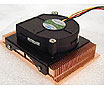
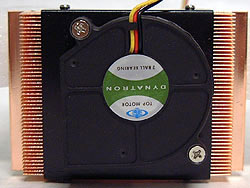
The Fan: The squirrel cage fan is not
typically used in this way, but this offers an ingenious solution to the
vertical height constraints of the 1U rack mount environment. Because
air is being exhausted to one side out the top, it is important to ensure
that the intake is being dawn in through the fins themselves. Since there
is no gasketting between the squirrel cage intake and the fan shroud it is
possible that some air is taking the path of least resistance
and forgoing the route through the copper fins. The fan draws power from
a standard three-pin motherboard header which supports RPM monitoring.
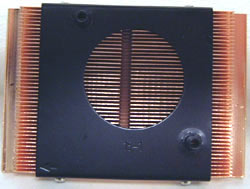
Heatsink Top:
This hole in the fan shroud serves as
the intake for the fan - air is drawn in through either side of the copper heatsinks'
fins, and up through this hole. The fan is mounted on two small posts which hold it firmly in
place.
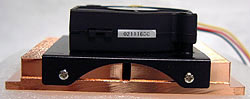
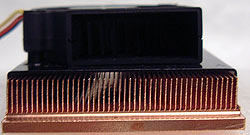
Side A: From the side you can
appreciate just how small this heatsink really is. The DC1U-B02
heatsink measures just 14mm tall, with the entire package (fan and heatsink) coming in under the 30mm mark.
The fan shroud is a one size fits all affair. The same components
are used for the Socket A version of this cooler. The shroud is
held in place with four screws and leaves about 8mm of fins exposed on either
side.
Side B:
The copper base measures 4mm thick and the fins
are about 0.3mm thick. Each of the 35 fins
are spaced 1mm apart to ensure good airflow intake. One of the nice benefits
of a skived heatsink is that the fins are so thin they pose
little resistance to air. There is no solder joint since the fins and base
are one and the same. Each fin measures 8mm tall.
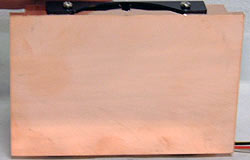
Heatsink Base: The base has been face milled perfectly flat, and is very smooth.
Only a small amount of thermal compound should be used with a base
of this finish. Too much compound would actually get stuck between the
heatsink and processor heatspreader instead of filling in the few microvoids
in the metal surface finish.