TOP 5 Heat Sinks TOP 5 Low Profile Heat Sinks TOP 5 Liquid Coolers
Heatsinks by Brand / Mfgr Reviews + Articless Advanced Search
|
TOP 5 Heat Sinks TOP 5 Low Profile Heat Sinks TOP 5 Liquid Coolers Heatsinks by Brand / Mfgr Reviews + Articless Advanced Search |
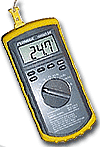
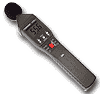
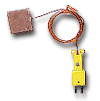
The equipment that FrostyTech uses when evaluating heatsinks and other cooling products has been developed to best gauge the various qualities of today's cooling solutions. To maintain the best possible correlation between heatsinks, all of our tests our synthetic. From our experience, synthetic testing provides the most accurate and reproducible sets of results. Our methodology currently focuses on the thermal performance of a heatsink on two different sized copper interface dies, tested at 50W and 100W heat loads. Acoustically, we record the noise signature of a particular fan and heatsink combo. Sound Level Measurements To measure the level of sound produced by a heatsink in decibels, we use an Omega HHSL1 sound meter. The HHSL1 is highly accurate between a range of 35-130 dB. To measure the level of noise produced, a heatsink is placed on a Melamine foam surface and the meter positioned about 12" above it and off to one side. The highest average level of noise is recorded. Frosty Acoustic Sampling Chamber:To record the noise generated by a particular fan and heatsink combination, we use a special enclosure box lined with 2" of foam which is sealed from the outside environment during the recording process. The thick layer of foam helps to ensure that the sound we record is only that generated by the heatsink/fan inside. A standard computer power supply is located outside the enclosure to power the heatsinks' fan. A monophonic microphone is positioned about 6" from the center of the test chamber so it is out of the direct air flow path generated by the fan. A solid state digital recorder is used record the sound picked up by the nondirectional mic inside the case. The digital recorder has a frequency range of approximately 500Hz to 3500Hz. The purpose of the enclosure is to record an accurate representation of the noise generated by a heatsink and fan combo - separate from any other external computer noises like hard drives or power supplies. FrostyTech Synthetic Temperature Test Platform: The FrostyTech Synthetic Temperature Test Platform consists of an aluminum block heated by up to two 120V 250 Ohm precision resistors. With one resistor engaged, the test platform will output 50W of heat, with both engaged, 100W. The heat is transmitted to the test heatsink via special copper interface dies with embedded type-K thermocouples. The test temperatures are recorded from within these copper interface dies which approximately replicate the surface area of various FC-PGA and heatspreader covered processors. The correlation is not one-to-one for every single possible core surface area, but rather an aggregate. Since each of the interface dies have the approximate surface area of either a bare silicon core or heatspreader covered processor, the flow of heat to the base of the heatsink is accurately mimicked. An Omega HH501DK Type-K digital thermometer is used to record the temperature from the interface die once everything has thermally stabilized. The test is conducted at 50W, and again at 100W for each of the interface dies. All heatsinks are tested using a good quality silver based thermal compound and all original thermal interface materials are removed. Now that we've explained a little about how we test the heatsinks that cross our path, lets move forward and take a closer look at test results for today's heatsink.
|
 |
|
| |||||||||||||||||||||||||||||||||||||||||||||||
|
Find a Heatsink . Latest Heatsink Reviews . Top 5 Heatsinks Tested . Top 5 Low Profile Heatsinks . Top 5 Liquid Coolers . Heatsinks by Mfgr / Brand |
Social Media |
FrostyTech.com Info . Feedback . Contact Us / Heatsink Submissions . Submit News . Privacy Policy |
 | |
© Copyright 1999-2025 www.frostytech.com All Rights Reserved. Privacy policy and Terms of Use Images © FrostyTech.com and may not be reproduced without express written permission. Current students and faculty of accredited Universities may use Frostytech images in research papers and thesis, provided each image is attributed. | ||||