TOP 5 Heat Sinks TOP 5 Low Profile Heat Sinks TOP 5 Liquid Coolers
Heatsinks by Brand / Mfgr Reviews + Articless Advanced Search
|
TOP 5 Heat Sinks TOP 5 Low Profile Heat Sinks TOP 5 Liquid Coolers Heatsinks by Brand / Mfgr Reviews + Articless Advanced Search |
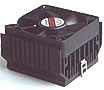
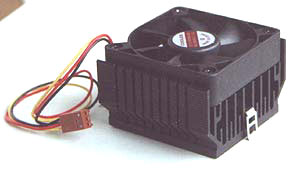
Socket 370/A Heatsink Review OEM heatsinks are known not so much for their amazing performance but for their affordability and offers of decent cooling performance. Sort of a Ford Topaz line of heatsinks! They're inexpensive and they work... for the most part. They work even better if you take a few moments to make one little modification. The modification is very simple and the improvement is substantial enough to make this decent heatsink cooler by an extra 6 degrees! More on that in a second though...
The Synthetic Heat Test To test out the socket 370/A cooler we used the FrostyTech Synthetic Test Apparatus. The device allows us to accurately load a heatsink with a known and consistently repeatable 50W heat load. The heat sink itself is tested on two different copper die templates. Each template has an imbedded thermistor. Temperature values are recorded from this thermistor once they have stabilized during the test. A small copper die template represents the surface area associated with FC-PGA or SocketA processors. FC-PGA type CPU's have only a small silicon core in contact with the base of the heatsink. The other copper die template is slightly larger and corresponds to the surface area of a Celeron PGA processor which has larger metallic heat spreader plate in contact with the heatsink. Some heatsinks have thin bases which are poor at distributing heat from the processor across the base of the heatsink. The two individual tests serve as an important guage for heatsinks in both cooling situations.
The results of our testing with the socket 370/A cooler show nothing more than average performance with a 36 C rise in temperature above the abient. It faired well below that of our Frosty CopperSink and KingCooler's Thermal Buster reference heatsink. It only managed to perform slightly better than that of the the ElanVital Celeron PGA heatsink.
Amazingly, this processor performance even poorer when we first tested it. The socket 370/A comes out of the box with a small thermal pad stuck to the base. The thermal pad is meant to help transmit the heat from the cpu to the heatsink regardless of poor surface finish. As the socket 370/A has a brushed base, this would seem like a welcome feature. In actuality, the pad
proves to insulate the cpu more than it effectively transfers heat. We removed
this little "thermal" pad and our temperature readings dropped by 6 degrees instantly! Conclusions: All in all, this socket 370/A heatsink looks good for its large size but really makes an average choice for FC-PGA or Socket A processors. It proves more than adequate when used for cooling older Celeron PGA-type processors however. It may be able to keep a processor from melting under its own load but it definitely won't keep it anywhere near room temperature. |
 |
|
| ||||||||||||||||||||||||||||||||||||||||||||||||||||||||||||||||||||||||||||||||||||||||||||
|
Find a Heatsink . Latest Heatsink Reviews . Top 5 Heatsinks Tested . Top 5 Low Profile Heatsinks . Top 5 Liquid Coolers . Heatsinks by Mfgr / Brand |
Social Media |
FrostyTech.com Info . Feedback . Contact Us / Heatsink Submissions . Submit News . Privacy Policy |
 | |
© Copyright 1999-2025 www.frostytech.com All Rights Reserved. Privacy policy and Terms of Use Images © FrostyTech.com and may not be reproduced without express written permission. Current students and faculty of accredited Universities may use Frostytech images in research papers and thesis, provided each image is attributed. | ||||
 The results are not too impressive for the socket
370/A heatsink under high load from a small surface area FC-PGA type
die.
The results are not too impressive for the socket
370/A heatsink under high load from a small surface area FC-PGA type
die.