TOP 5 Heat Sinks TOP 5 Low Profile Heat Sinks TOP 5 Liquid Coolers
Heatsinks by Brand / Mfgr Reviews + Articless Advanced Search
|
TOP 5 Heat Sinks TOP 5 Low Profile Heat Sinks TOP 5 Liquid Coolers Heatsinks by Brand / Mfgr Reviews + Articless Advanced Search |
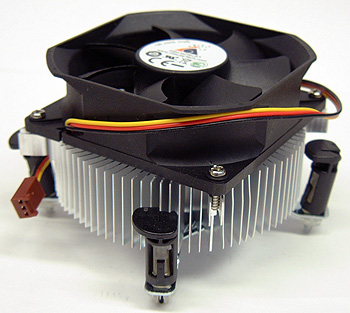
The Glacialtech Igloo 5057 E is a socket 775 Intel heatsink for Pentium D, Core 2 Duo and Celeron processors. Owing to its all-aluminum construction, the Igloo 5057E is probably best used on sub-90W processors. There are several families of new Intel Core 2 Duo processors which boast 65W ratings - pretty much all of the 65nm and 45nm chips in fact. Now to be frank, any company going up against Intel for LGA775 heatsinks has its work cut out for it. Intel's stock heatsinks are generally well built, operate quietly and cool, and are bundled in with each and every retail processor at no added cost. Most heatsink manufacturers have to differentiate on performance and features, since "free" is rather hard to compete against. In any case, ours is not to examine the many marketing aspects of the Glacialtech Igloo 5057 E heatsink. Frostytech is only concerned with three attributes; thermal performance, acoustic performance, and build quality. Test results are the route we'll take, and in this regard the Glacialtech Igloo 5057 E has an 80mm fan and a solid aluminum body working in its favour. Simple construction should translate into a retail cost on the order of $18 bucks.
Made by Taiwanese heatsink manufacturerGlacialtech, the Igloo 5057 E is a straight forward radial fin cooler patterned on the original Intel designs. The Igloo 5057 E features a 3200RPM fan, weighs in under 300grams and attaches to the motherboard with Intel's standard push-to-lock through-PCB retention clips. The heatsink is shipped with a pre-applied patch of high viscosity thermal compound on its base. FrostyTech's Test Methodologies are outlined in detail here if you care to know what equipment is used, and the parameters under which the tests are conducted. Now let's move forward and take a closer look at this heatsink, its acoustic characteristics, and of course its performance in the thermal tests!
|
 |
|
| |||||||||||||||||||||||||||||||||||||||||
|
Find a Heatsink . Latest Heatsink Reviews . Top 5 Heatsinks Tested . Top 5 Low Profile Heatsinks . Top 5 Liquid Coolers . Heatsinks by Mfgr / Brand |
Social Media |
FrostyTech.com Info . Feedback . Contact Us / Heatsink Submissions . Submit News . Privacy Policy |
 | |
© Copyright 1999-2025 www.frostytech.com All Rights Reserved. Privacy policy and Terms of Use Images © FrostyTech.com and may not be reproduced without express written permission. Current students and faculty of accredited Universities may use Frostytech images in research papers and thesis, provided each image is attributed. | ||||