TOP 5 Heat Sinks TOP 5 Low Profile Heat Sinks TOP 5 Liquid Coolers
Heatsinks by Brand / Mfgr Reviews + Articless Advanced Search
|
TOP 5 Heat Sinks TOP 5 Low Profile Heat Sinks TOP 5 Liquid Coolers Heatsinks by Brand / Mfgr Reviews + Articless Advanced Search |
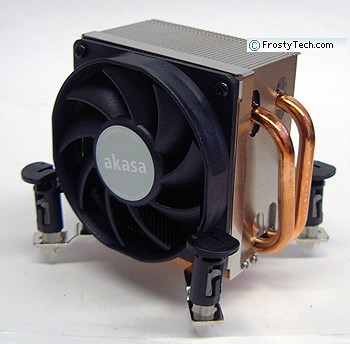
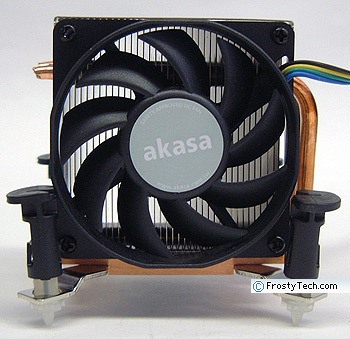
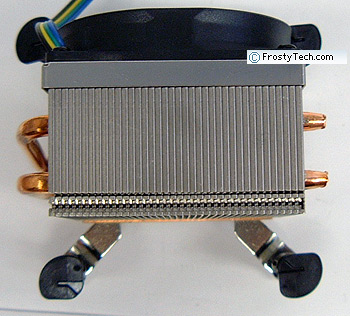
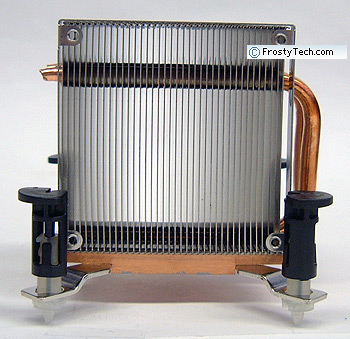
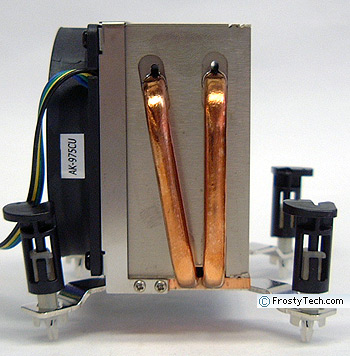
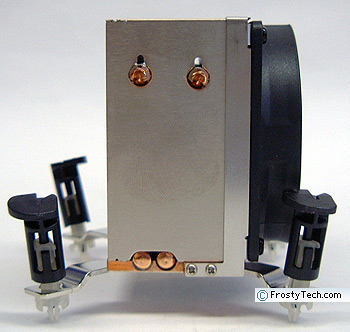
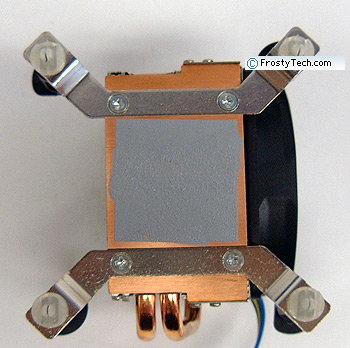
The Akasa AK-975Cu is a compact little Intel socket 775 heatsink that stands no more than 77mm tall. It comes with a 70mm PWM fan that varies in speed from 1000-3500RPM, and a convenient patch of pre-applied thermal compound on its base. The cooler is based on a copper block with aluminum fins and a pair of copper heatpipes to help distribute the heat to stubby cooling fins. All joints are soldered to lower thermal resistance. Installation is a snap because the Akasa AK-975Cu uses Intel's standard push-to-lock retention clips. The heatsink is compatible with socket 775 Intel Pentium D/4 and Core 2 Duo CPUs, specifically in a 2U rack mountable chassis environment. If you recall, servers and other rack mounted enclosures are packaged in boxes that conform to the 1U, 2U, 3U etc. sizes. Each Unit of space is equivalent to 1.75" (44mm). Generally, rack mounted enclosures utilized forced air cooling, whereby air is drawn into the chassis at the front by a phalanx of fans, and exhausted out the rear. Since heatsinks cannot exhaust up in such closed enclosures, and given that the prevailing air currents are all moving front to rear, exhausting down towards the motherboard can be inefficient. Thus most heatsinks for 1U or 2U enclosures direct airflow tangentially over cooling fins, as opposed to the more common impingement orientation used with desktop computer thermal solutions. Anyway, on with the review! The Akasa AK-975Cu is clearly a no frills workhorse heatsink, and it retail for in the region of $20USD ($22CDN). Quite affordable really.
The Akasa AK-975Cu is a pretty simple design, but the heatsink does rely upon two heatpipes. We're often asked to explain what heatpipes do, and don't... Think of it this way, as heat energy from the Intel processor reaches the two heatpipes, they move it from one spot to another. That's all. Heatpipes don't actually "cool", they're just very efficient at moving heat from one location to another, where fins or other heat exchangers do the actual "cooling" work. On the inside of the heatpipes a working fluid absorbs the latent heat from the processor, causing it to undergo a change of phase. In our daily lives, water boils at 100°C, but as pressure is decreased the temperature gradient required to make water convert to vapour also drops. This is the foundation of the principle used with heatpipes. Anyway, the working fluid inside converts to vapour as the temperature of the evaporator (hot side) of heatpipe increases. The liquid vapour is drawn towards the cooler end of the heatpipe where it condenses. As the hot vapour cools back into a liquid, the heat energy it stored is transferred back to the metal, but this time it is the surrounding cooling fins of the heatsink. The condensed vapour, now working fluid once again, is drawn back towards the hot evaporator end of the tube by capillary action along an internal wick structure. As the liquid reaches the hot end once more, the entire process repeats itself. The Akasa AK-975Cu heatsink will be tested on FrostyTech's Intel LGA775 version of the Mk.II synthetic thermal temperature test platform, and compared against several reference LGA775 heatsinks. The test methodology is outlined in detail here if you'd like to know what equipment is used, and the parameters under which the tests are conducted. Now let's move forward and take a closer look at this heatsink.
|
 |
|
| ||||||||||||||||||||||||||||||||||||||||||||||||||||||||||
|
Find a Heatsink . Latest Heatsink Reviews . Top 5 Heatsinks Tested . Top 5 Low Profile Heatsinks . Top 5 Liquid Coolers . Heatsinks by Mfgr / Brand |
Social Media |
FrostyTech.com Info . Feedback . Contact Us / Heatsink Submissions . Submit News . Privacy Policy |
 | |
© Copyright 1999-2025 www.frostytech.com All Rights Reserved. Privacy policy and Terms of Use Images © FrostyTech.com and may not be reproduced without express written permission. Current students and faculty of accredited Universities may use Frostytech images in research papers and thesis, provided each image is attributed. | ||||