TOP 5 Heat Sinks TOP 5 Low Profile Heat Sinks TOP 5 Liquid Coolers
Heatsinks by Brand / Mfgr Reviews + Articless Advanced Search
|
TOP 5 Heat Sinks TOP 5 Low Profile Heat Sinks TOP 5 Liquid Coolers Heatsinks by Brand / Mfgr Reviews + Articless Advanced Search |
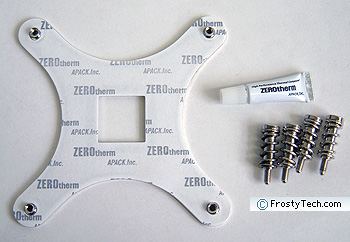
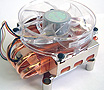
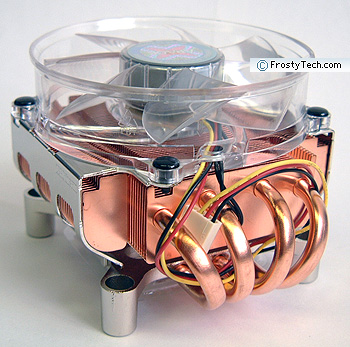
The Apack Zerotherm CF900 heatsink is a stubby little copper heatsink, and a good candidate for any socket 775 Intel Pentium D/Core 2 Duo based computer system. It has been designed to operate as quietly as possible, so the clear fan scales automatically to tackle heat loads as high as 130W. The thermally responsive fan adjusts its speed between 800-2300RPM, blowing upwards of 42CFM over 2300mm2 of cooling surface area. The CF900 heatsink is identical to the companies Zerotherm CF800 model, except that the Zerotherm CF900 uses of copper where the latter is all aluminum. Given identical geometries, it will be interesting to note what, if any, changes there are to thermal performance with the Zerotherm CF900 model. The Apack Zerotherm CF900 heatsink has four copper heatpipes which connect the copper base plate to the copper cooling fins above; consequently this little heatsink weighs a hefty 562 grams. The CF900 operates fairly quietly under power, which is always a good attribute in any heatsink. The CF900 installs with a set of its own spring tensioned screws, onto a supplied metal backplate. Unfortunately this necessitates removing the motherboard from the case first, to install the plate the CF900 attaches to. Like the CF800 model, Apack's Zerotherm CF900 ships with a pre-applied patch of Shin-etsu thermal compound.
The
Zerotherm CF900's Protechnic MGT9212HS-S25 fan has a thermistor attached to a
short length of wire coming out of the motor hub, and this plays a crucial role
in how the heatsink performs. At its slowest speed (800RPM), the 95mm diameter Protechnic fan barely produces 35 dBA noise. At its full speed of 2300RPM, the fan rumbles away with a moderately audible 48.3 dBA. A 3-pin power connector means this heatsink is not PWM compatible, but that doesn't really matter. The thermistor placement does a good job of allowing the fan to respond to the temperature load at any given moment.
The joints between the copper cooling fins and copper heatpipes appear to be soldered (or otherwise bonded), and similarly so for the joints between the copper base and heat pipes. The die cast aluminum mounting base is a bit of a puzzle though... It's big for starters, and it's also directly in contact with the copper heatpipes and copper base. The upper half of the aluminum mounting base is completely flat, and given that it is absorbing as much heat at the processor is putting out, it's hard to understand why Apack chose not to integrate some sort of low profile cooling fins here. The large aluminum die cast mounting plate sits directly under the copper fins, so it gets a full blast of air already... some fins would have only enhanced the heatsinks' thermal performance.
The Apack Zerotherm CF900 heatsink will be tested on FrostyTech's Intel LGA775 version of the Mk.II synthetic thermal temperature test platform, and compared against several reference LGA775 heatsinks. The whole test methodology is outlined in detail here if you care to know what equipment is used, and the parameters under which the tests are conducted. Now let's move forward and take a closer look at this heatsink, its acoustic characteristics, and of course it performance in the thermal tests!
|
 |
|
| |||||||||||||||||||||||||||||||||||||||||
|
Find a Heatsink . Latest Heatsink Reviews . Top 5 Heatsinks Tested . Top 5 Low Profile Heatsinks . Top 5 Liquid Coolers . Heatsinks by Mfgr / Brand |
Social Media |
FrostyTech.com Info . Feedback . Contact Us / Heatsink Submissions . Submit News . Privacy Policy |
 | |
© Copyright 1999-2025 www.frostytech.com All Rights Reserved. Privacy policy and Terms of Use Images © FrostyTech.com and may not be reproduced without express written permission. Current students and faculty of accredited Universities may use Frostytech images in research papers and thesis, provided each image is attributed. | ||||

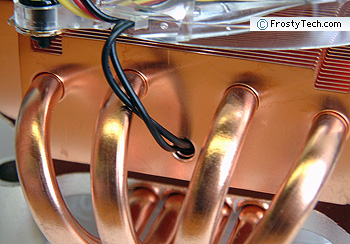 The thermistor is cleverly located inside a well formed within in the array of
copper cooling fins, so it accurately responds to the temperature of the metal, not the internal case
air temperature. This enables the Zerotherm CF900 fan to scale its impeller speed as necessary, and cuts down on unnecessary
noise.
The thermistor is cleverly located inside a well formed within in the array of
copper cooling fins, so it accurately responds to the temperature of the metal, not the internal case
air temperature. This enables the Zerotherm CF900 fan to scale its impeller speed as necessary, and cuts down on unnecessary
noise. 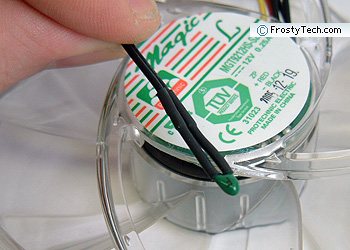 A set of four
copper heatpipes connect
the copper fins to the base of the heatsink, which is made up
of a large die cast aluminum mounting frame and a small 32x32mm small copper plate. The copper base plate makes direct contact with the processor's integrated
heat spreader for optimal heat transfer.
A set of four
copper heatpipes connect
the copper fins to the base of the heatsink, which is made up
of a large die cast aluminum mounting frame and a small 32x32mm small copper plate. The copper base plate makes direct contact with the processor's integrated
heat spreader for optimal heat transfer.