TOP 5 Heat Sinks TOP 5 Low Profile Heat Sinks TOP 5 Liquid Coolers
Heatsinks by Brand / Mfgr Reviews + Articless Advanced Search
|
TOP 5 Heat Sinks TOP 5 Low Profile Heat Sinks TOP 5 Liquid Coolers Heatsinks by Brand / Mfgr Reviews + Articless Advanced Search |
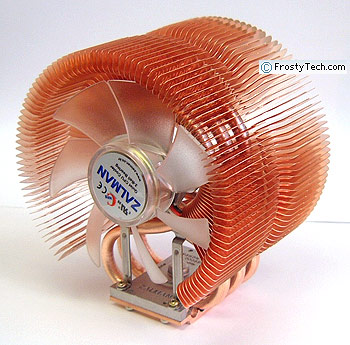
During Computex 2005, word quickly spread about a giant figure-eight shaped meter tall copper heatsink at the Zalman Tech co. booth on the Taipei trade show floor. That heatsink was an attention grabber for certain, and now that the Zalman CNPS9500 LED heatsink is in full production we're pleased to present this review of it to you.
The Zalman CNPS9500 LED heatsink is compatible with all current AMD and Intel socket formfactors (including Sockets 775, 478, 939, 940, 754), and weighs in at roughly 530grams. The heatsink is voluminous, but designed to operate quietly and cool under low noise, low fan-speed conditions. At full speed, its translucent 92mm diameter fan spins at conservative 2600RPM, but turn down the dial on the FanMate 2 and that speed drops to 1350RPM. Three heatpipes bent into a figure-eight form the backbone of the CNPS9500 LED heatsink, and the rest of the design is simply form following function to a "T."
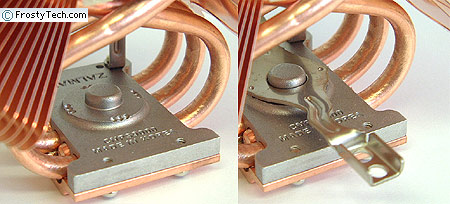
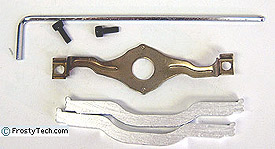
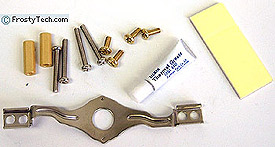
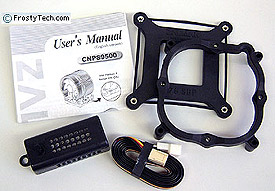
The complex shape of the Zalman CNPS9500 LED makes the proposition of installing it onto a CPU about as endearing as mid-terms... but the process is remarkably easy. The heatsink comes with a set of clips and retention frames for socket 775, socket 478, and socket 939/745/940 motherboards. The clip mechanism for the socket 775 Pentium 4 is the most complicated as it demands the entire motherboard be removed first for the installation of a special back plate. The rest are pretty easy, and either utilize the exiting socket retention frames or require nothing more than a screwdriver.
For the purposes of Frostytech's tests, we went about configuring the Zalman CNPS9500 LED for an Athlon64 system (socket 939/754/940). To do this, a special steel clip is either threaded perpendicularly in between a couple of the copper heatpipes, or parallel (pictured above) to them. The method users will use depends on how the CPU socket is oriented on the motherboard as Zalman recommend that the exhaust from the Zalman CNPS9500 LED always be blowing towards the rear of the chassis.
We should also mention the following restrictions that may prevent the Zalman CNPS9500 LED from installing correctly; 1.) no interfering components within 56mm of the center of the CPU (to the front or back), and none within 45mm from the center of the CPU to the top or bottom. 2.) there must be at least 135mm space above the CPU socket in the chassis for the CNPS9500 LED to fit. FrostyTech's new Test Methodology is outlined in detail here if you care to know what equipment is used, and the parameters under which the tests are conducted. Now let's move forward and take a closer look at this heatsink, its acoustic characteristics, and of course it performance in the thermal tests!
|
 |
|
| |||||||||||||||||||||||||||||||||||||||||||||
|
Find a Heatsink . Latest Heatsink Reviews . Top 5 Heatsinks Tested . Top 5 Low Profile Heatsinks . Top 5 Liquid Coolers . Heatsinks by Mfgr / Brand |
Social Media |
FrostyTech.com Info . Feedback . Contact Us / Heatsink Submissions . Submit News . Privacy Policy |
 | |
© Copyright 1999-2025 www.frostytech.com All Rights Reserved. Privacy policy and Terms of Use Images © FrostyTech.com and may not be reproduced without express written permission. Current students and faculty of accredited Universities may use Frostytech images in research papers and thesis, provided each image is attributed. | ||||