TOP 5 Heat Sinks TOP 5 Low Profile Heat Sinks TOP 5 Liquid Coolers
Heatsinks by Brand / Mfgr Reviews + Articless Advanced Search
|
TOP 5 Heat Sinks TOP 5 Low Profile Heat Sinks TOP 5 Liquid Coolers Heatsinks by Brand / Mfgr Reviews + Articless Advanced Search |
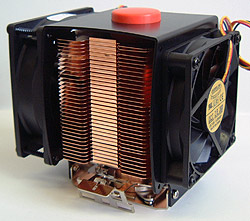
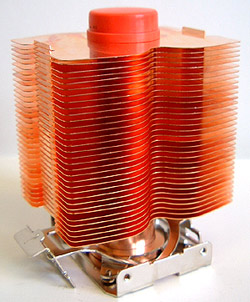
nPowerTek TTIC NPH-201 Socket A Heatsink Review The Thermal Transtech International Corp. NPH-201 Socket A heatsink is at first glance a cooler with a rather large central heatpipe. That assessment is just about correct, except that the large column supporting its many copper fins is not technically a heatpipe as we know it. It is what TTIC have termed a "heat column." This column, 25mm in diameter and made from a hollow copper cylinder, has a chemical coating on the inside that works to the same effect as a wick in a traditional heatpipe... at least as far as we can glean from TTICs patent on the technology. The heat column as it called by the manufacturer, absorbs heat from the AthlonXP core and disperses it to approximately 30 copper fins measuring roughly 60x75mm in size. The 25mm diameter copper column passes up through the center of each of the 0.2mm thick copper fins, transferring the heat energy to them in the process. A set of fans arranged in a push-pull configuration provide the necessary airflow to remove the heat from the fins of the heatsink to the surrounding environment.
According to this documentation by QuTech, the heat column used here is essentially an empty cylinder of copper which has been internally coated with a thin "superconducting heat transfer medium." The copper cylinder is sealed off at both ends, and inside is under a vacuum of approximately 1 Torr.
While this 'heat column' technology has surfaced on a few heatsinks we've tested already, it may be slower to adopt in spite of its otherwise promising attributes. Also, since most people would be hard pressed to explain what a heatpipe is, or does, the "superconducting" heatpipe, or heat column is probably going to continue to generate a lot of confusion. Anyhow, on with the review of the TTIC NPH-201!
|
 |
|
| |||||||||||||||||||||||||||||
|
Find a Heatsink . Latest Heatsink Reviews . Top 5 Heatsinks Tested . Top 5 Low Profile Heatsinks . Top 5 Liquid Coolers . Heatsinks by Mfgr / Brand |
Social Media |
FrostyTech.com Info . Feedback . Contact Us / Heatsink Submissions . Submit News . Privacy Policy |
 | |
© Copyright 1999-2025 www.frostytech.com All Rights Reserved. Privacy policy and Terms of Use Images © FrostyTech.com and may not be reproduced without express written permission. Current students and faculty of accredited Universities may use Frostytech images in research papers and thesis, provided each image is attributed. | ||||


 Patent no. 6,132,823 explains
QuTech's very interesting and potentially revolutionary process to the topic of
heatpipes, entitled
Patent no. 6,132,823 explains
QuTech's very interesting and potentially revolutionary process to the topic of
heatpipes, entitled 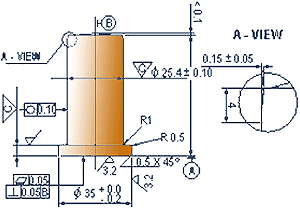 A convectional heat pipe makes use of
the technique of liquids vaporizing upon absorbing great amounts of heat and
vapors cooling upon emitting heat so as to bring the heat from the pipe's hot
end to its cold end. The axial heat conducting velocity of the heat pipe
depends on the value of the liquid's vaporization potent heat and the
circulation speed between two forms of liquid and vapor. The axial heat
conducting velocity of the heat pipe also is restrained by the type and
quantity of the carrier material and the temperatures and pressures at which
the heat pipe operates (it can not be too high).
A convectional heat pipe makes use of
the technique of liquids vaporizing upon absorbing great amounts of heat and
vapors cooling upon emitting heat so as to bring the heat from the pipe's hot
end to its cold end. The axial heat conducting velocity of the heat pipe
depends on the value of the liquid's vaporization potent heat and the
circulation speed between two forms of liquid and vapor. The axial heat
conducting velocity of the heat pipe also is restrained by the type and
quantity of the carrier material and the temperatures and pressures at which
the heat pipe operates (it can not be too high).