TOP 5 Heat Sinks TOP 5 Low Profile Heat Sinks TOP 5 Liquid Coolers
Heatsinks by Brand / Mfgr Reviews + Articless Advanced Search
|
TOP 5 Heat Sinks TOP 5 Low Profile Heat Sinks TOP 5 Liquid Coolers Heatsinks by Brand / Mfgr Reviews + Articless Advanced Search |
Cooljag JVC258A V-Type Copper Base Heatsink Review
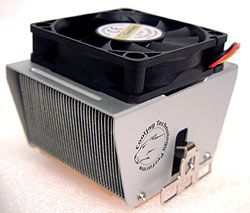
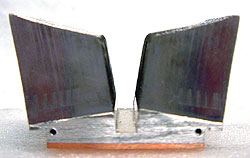
The triangular shaped base section, and the V-shaped fins are something we haven't seen before on a skived heatsink, and judging by the thermal results of the JVC258A, this won't be the last time either. Not only does the upwards expansion out allow the heatsink to come equipped with a larger fan, but it also helps induce efficient exhaust judging by the looks of it. As if the CoolJag V-Type technology weren't enough to focus on, this heatsink also packs a 3mm thick copper base that is just about as smooth as a babies bottom. The noise signature of the CoolJag JVC258A is moderate given the 60mm fan, and that is something we always look forward too... not hearing.
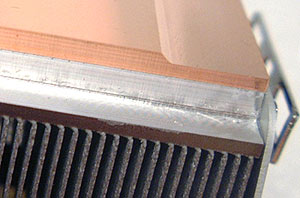
We like to find out as much as we can about each heatsink we test out, so that typically means they're taken apart and scrutinized. As the CoolJag JVC258A was going through testing we were trying to figure out just how the copper base had been attached to aluminum. The answer came when we removed the fan shroud for some photos. Looking under the clip it was clear that at least a portion of the heatsink had been nickel plated, a medium to which the copper could then be soldered to. To finish things off for a clean appearance, the edges were then machined away yielding the nice interface you see here.
Another interesting point to consider is how the clip has been integrated into the JVC258A for better protection of the AthlonXP processor core. Not only does the spring clip make use of all three tabs of the socket, but one edge is held in place so that the heatsink will not need to be tilted on the core - an act which could chip the edge of the brittle silicon.
|
 |
|
| |||||||||||||||||||||||||||||
|
Find a Heatsink . Latest Heatsink Reviews . Top 5 Heatsinks Tested . Top 5 Low Profile Heatsinks . Top 5 Liquid Coolers . Heatsinks by Mfgr / Brand |
Social Media |
FrostyTech.com Info . Feedback . Contact Us / Heatsink Submissions . Submit News . Privacy Policy |
 | |
© Copyright 1999-2025 www.frostytech.com All Rights Reserved. Privacy policy and Terms of Use Images © FrostyTech.com and may not be reproduced without express written permission. Current students and faculty of accredited Universities may use Frostytech images in research papers and thesis, provided each image is attributed. | ||||

 With a Jaguar logo on the side of their heatsinks, and a
new heatsink technology that goes by the name of "V-Type", you'd be
forgiven for thinking that CoolJag was a some new car company. It
isn't of course. The new
With a Jaguar logo on the side of their heatsinks, and a
new heatsink technology that goes by the name of "V-Type", you'd be
forgiven for thinking that CoolJag was a some new car company. It
isn't of course. The new