TOP 5 Heat Sinks TOP 5 Low Profile Heat Sinks TOP 5 Liquid Coolers
Heatsinks by Brand / Mfgr Reviews + Articless Advanced Search
|
TOP 5 Heat Sinks TOP 5 Low Profile Heat Sinks TOP 5 Liquid Coolers Heatsinks by Brand / Mfgr Reviews + Articless Advanced Search |
Dynatron DC1U-B01 1U Copper Heatsink Review
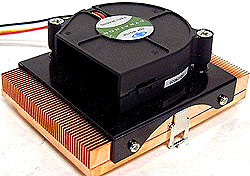
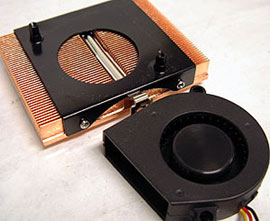
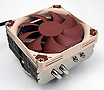
Dynatron's all copper DC1U-B01 Socket A heatsink is designed for use in 1U server environments, but, does it have the right stuff? We've tested hundreds of heatsinks and only handful have ever used squirrel cage fans because of their low CFM ratings. Has Dynatron figured out the secret to making the worlds best 1U socket A heatsink, or are we looking at something which just makes the grade? Read on and you'll find out those questions and many more! First off, lets have a look at the heatsink itself and consider that 1U servers only leave about 30mm worth of vertical space for the entire cooling package; that means heatsink and fan. Ensuring that the total thermal solution will work within the limits set out by processor manufacturer usually means that with the size limitations, 1U heatsinks always test hotter than standard desktop coolers. This isn't to say they run that hot in the server as forced air usually adds a degree of cooling we just can't factor in. In any case, the Dynatron DC1U-B01 is set for some competition from a few other Socket A 1U server heatsinks.
You will be hearing us mention the work "skive" quite a lot in this review, and if you aren't familiar with the term there is no need to fret. 'Skiving' is a manufacturing process by which the copper fins of the heatsink are drawn up from a flat plate or bar of copper to form the final heatsink. The remains of that flat plate go on to form the base of the actual heatsink. The significance of this set up is that there is no interface to be concerned with between the fins and base. Materials such as solder, or thermal epoxy can impede the flow of heat energy more so than pure copper. Skived heatsinks make those concerns obsolete.
|
 |
|
| |||||||||||||||||||||||||||||||
|
Find a Heatsink . Latest Heatsink Reviews . Top 5 Heatsinks Tested . Top 5 Low Profile Heatsinks . Top 5 Liquid Coolers . Heatsinks by Mfgr / Brand |
Social Media |
FrostyTech.com Info . Feedback . Contact Us / Heatsink Submissions . Submit News . Privacy Policy |
 | |
© Copyright 1999-2025 www.frostytech.com All Rights Reserved. Privacy policy and Terms of Use Images © FrostyTech.com and may not be reproduced without express written permission. Current students and faculty of accredited Universities may use Frostytech images in research papers and thesis, provided each image is attributed. | ||||