TOP 5 Heat Sinks TOP 5 Low Profile Heat Sinks TOP 5 Liquid Coolers
Heatsinks by Brand / Mfgr Reviews + Articless Advanced Search
|
TOP 5 Heat Sinks TOP 5 Low Profile Heat Sinks TOP 5 Liquid Coolers Heatsinks by Brand / Mfgr Reviews + Articless Advanced Search |
Dynatron DC1U-B02 1U Copper Heatsink Review
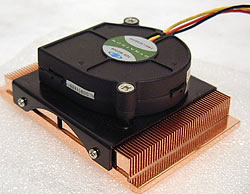
For companies in the business of companies designing 1U server heatsinks the requirements that come into play are drastically different than that of a normal desktop PC. First of all there are the size limitations, and then there are the reliability factors. In virtually all cases there is some amount of forced air moving through the rack enclosure so some amount of passive cooling also comes into play irregardless of the heatsinks' features. However, with 'whitebox' servers comes the lack the engineering benefits that come part in parcel with designing an enclosure specifically for the application. Processor sockets may not be oriented for correct cooling by forced convention, it all depends and it's even harder to predict. The solution to such dilemmas could be to use an active heatsinks such as the all copper Dynatron DC1U-B02 cooler which features a squirrel cage fan up top. However, as there is generally no more than about 30mm of height for the entire cooling package, fans will obviously take up precious real estate. Ensuring that the total thermal solution will work within the limits set out by processor manufacturer usually means that with the size limitations, 1U heatsinks always test hotter than standard desktop coolers. This isn't to say they run that hot in the server as forced air usually adds a degree of cooling we just can't factor in because it is so enclosure specific. In any case, the Dynatron DC1U-B02 is set for some competition from the 1U Vantec CCK-7015, and a few other heatsinks for Socket 478 Intel processors.... so let's move on with the review!
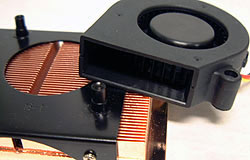
Skiving is a process by which the copper fins of the heatsink are drawn up from a flat plate or bar of copper. The remains of that flat plate go on to form the base of the actual heatsink which means the thermal properties should be very good. The significance of this set up is that there is no interface to be concerned with between the fins and base. Materials such as solder, or thermal epoxy can impede the flow of heat energy more so than pure copper.
Since the heatsink makes use of an alternate form of HSRM, the cooler ships with its own complete socket. Installation may be a bit more tricky than other heatsinks since the motherboard will have to be removed to allow the HSRM that comes with this cooler to be installed.
|
 |
|
| |||||||||||||||||||||||||||||||
|
Find a Heatsink . Latest Heatsink Reviews . Top 5 Heatsinks Tested . Top 5 Low Profile Heatsinks . Top 5 Liquid Coolers . Heatsinks by Mfgr / Brand |
Social Media |
FrostyTech.com Info . Feedback . Contact Us / Heatsink Submissions . Submit News . Privacy Policy |
 | |
© Copyright 1999-2025 www.frostytech.com All Rights Reserved. Privacy policy and Terms of Use Images © FrostyTech.com and may not be reproduced without express written permission. Current students and faculty of accredited Universities may use Frostytech images in research papers and thesis, provided each image is attributed. | ||||