TOP 5 Heat Sinks TOP 5 Low Profile Heat Sinks TOP 5 Liquid Coolers
Heatsinks by Brand / Mfgr Reviews + Articless Advanced Search
|
TOP 5 Heat Sinks TOP 5 Low Profile Heat Sinks TOP 5 Liquid Coolers Heatsinks by Brand / Mfgr Reviews + Articless Advanced Search |
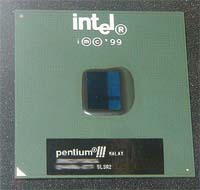
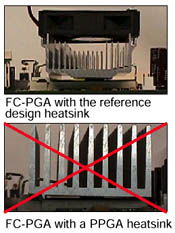
CuMines and heatsinks - what to know The PIII Coppermine is based upon the FC-PGA form factor. While the CuMine fits in the PPGA-370 socket, it is not compatable unless the socket has been specifically designed for it due to differing voltages and pin-outs between Celerons and CopperMines. A similar situation exists with heatsinks originally designed for PPGA-370 Celerons. In a document released by Intel entitled "Manufacturing with 800Mhz Intel Pentium III (256K) in the FC-PGA Form Factor with reference design" some advice is given to help OEM's deal with heatsink seating problems. We summarize the important bits here, as the document had a lot of extra info only OEM's would be interested in.
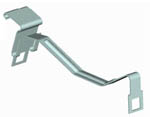
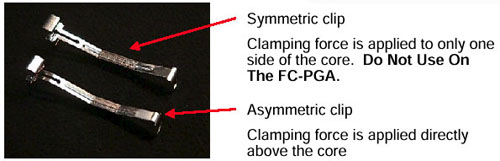
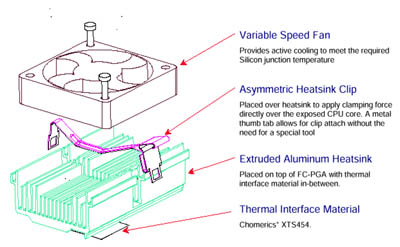
In terms of the heatsinks used previously to cool Celerons, the part that affects compatibility is the clip. Just about any good heatsink can be used interchangeably between the two processors, but the clips which attach those heatsinks are not compatable. Where Celerons use symmetric clips, Coppermines require asymmetric clips for proper attachment. However asymetric clips have the advantage of working on both Coppermine and Celeron platforms.
|
 |
|
| |||||||||||||||||||||
|
Find a Heatsink . Latest Heatsink Reviews . Top 5 Heatsinks Tested . Top 5 Low Profile Heatsinks . Top 5 Liquid Coolers . Heatsinks by Mfgr / Brand |
Social Media |
FrostyTech.com Info . Feedback . Contact Us / Heatsink Submissions . Submit News . Privacy Policy |
 | |
© Copyright 1999-2025 www.frostytech.com All Rights Reserved. Privacy policy and Terms of Use Images © FrostyTech.com and may not be reproduced without express written permission. Current students and faculty of accredited Universities may use Frostytech images in research papers and thesis, provided each image is attributed. | ||||