TOP 5 Heat Sinks TOP 5 Low Profile Heat Sinks TOP 5 Liquid Coolers
Heatsinks by Brand / Mfgr Reviews + Articless Advanced Search
|
TOP 5 Heat Sinks TOP 5 Low Profile Heat Sinks TOP 5 Liquid Coolers Heatsinks by Brand / Mfgr Reviews + Articless Advanced Search |
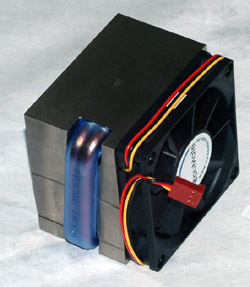
CPUmate DIA-10500 Heatpipe Pentium 4 Heatsink Review CPUMate Inc are an ISO9001 certified company based in Taiwan which have been producing heatsinks since late 2001. As a new company in a highly competitive market which is often "cut throat," innovation is the only way to survive, and thrive. Up until this point it has been evident that CPUmate have not had much if any North American experience. With the results of the DIA-1500 in hand it's safe to say that further advancements along this line of design will bring greater exposure to this company. The cooling solution CPUmate base their heatsink around is nothing more than two interlocking nickel plated extruded aluminum heatsinks which are inexpensive to produce, but throw in a set of heatpipes and the equation changes. While we have seen similar examples (sans heatpipes) from other Taiwanese manufacturers which have proved disappointing, CPUmate have added the right technology in the right way, endowing the DIA-10500 with some fairly good performance characteristics.
Heatpipes can be very useful additions to a heatsink - enabling it to work harder under the same airflow parameters. Heatpipes can also be ill designed for a particular heatsink and offer little or no realistic benefit to the overall cooling capability. In this instance, CPUmate have engineered a very simple and effective solution, that while not entirely quiet, it does posses very good thermal properties for its size and materials.
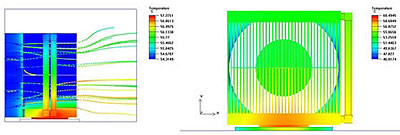
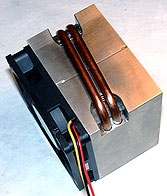
Essentially what we are seeing is this; a single heatsink extrusion has been designed in such away that placed fin-to-fin, the metal can be locked in place forming one full heatsink. Now that is not to say that heat energy travels 'magically' from base of the bottom heatsink up along the side fins to the top heatsink.The side fins are simply too thin (2mm thick), and the thermal values too low for this to work to any significant degree. The point of doubling up the heatsinks is two-fold. First of all, with the twin heatpipes joining the two aluminum extrusions heat energy is transferred via the heatpipes from the base of the lower heatsink to the base of the upper heatsink where it is dispersed to the surrounding fins. Secondly, by increasing surface area in this fashion the overall pressure drop of the air as it moves through the two sets of heatsinks is lower, enabling a smaller 15mm x 70mm x 70mm fan to be used. There is no plenum here so I think the design still needs a little more tweaking.
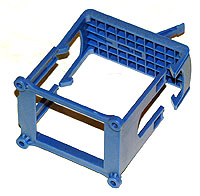
Along with the non-standard sized heatsink comes a custom blue heatsink retention mechanism. The mounting points are compatible with all Pentium 4 motherboards, and the length of the HSRM is about the same as standard unit, but the width is much smaller. A typical Pentium 4 heatsink is on the order of 70mm wide; the CPUmate is just 45mm. To mount the CPUMate DIA-10500, it is simply a matter of removing the stock Intel HSRM, and replacing it with the custom HSRM included in the package.
|
 |
|
| |||||||||||||||||||||||||||||||||
|
Find a Heatsink . Latest Heatsink Reviews . Top 5 Heatsinks Tested . Top 5 Low Profile Heatsinks . Top 5 Liquid Coolers . Heatsinks by Mfgr / Brand |
Social Media |
FrostyTech.com Info . Feedback . Contact Us / Heatsink Submissions . Submit News . Privacy Policy |
 | |
© Copyright 1999-2025 www.frostytech.com All Rights Reserved. Privacy policy and Terms of Use Images © FrostyTech.com and may not be reproduced without express written permission. Current students and faculty of accredited Universities may use Frostytech images in research papers and thesis, provided each image is attributed. | ||||