TOP 5 Heat Sinks TOP 5 Low Profile Heat Sinks TOP 5 Liquid Coolers
Heatsinks by Brand / Mfgr Reviews + Articless Advanced Search
|
TOP 5 Heat Sinks TOP 5 Low Profile Heat Sinks TOP 5 Liquid Coolers Heatsinks by Brand / Mfgr Reviews + Articless Advanced Search |
Zalman 300W ZM300A-APF Quiet Power Supply
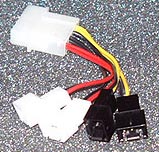
Zalman have founded their company on the concept of providing cooling and related products which adhere to their own CNPS (Computer Noise Prevention System) standards. So as we opened up the box for the ZM300A-APF a low noise power supply greeted us. From the outside there is no difference between this power supply and any other you can see except for the lack of a 115V-250V selector switch (this power supply has circuitry which doesn't require it). The ATX 2.03 compatible power supply is Pentium 4 compliant and supplies a healthy 300W of juice to the computer. Zalman's power supply comes with one internal exhaust fan, (7) molex connectors, (2) FDD connectors, a 24-pin ATX connector, and a 6-pin & 4-pin Pentium 4 auxiliary power connector. Additionally, to make powering all those case fans we have these days easier, this goes against the low-noise mantra just slightly, Zalman also include a rather handy Molex-to-four 3-pin fan headers connector. Two of those fan headers supply 12V, and two supply a lower voltage for quieter cooling possibilities (5V). Along with the power supply come a fairly detailed set of instructions. Within the booklet are a set of good technical explanations behind the ZM300A. I think it's worth quoting two of the sections here for a better understanding of what goes into making a reliable, and good power supply. Wattage and noise levels are only one facet after all. The most important component can be the internal circuitry which is almost always transparent to the user.
The power cables are nice and long at about 55 cm which is great for those tall tower cases. For those users there is always the concern of power cables not reaching the lower components. With the ZM300A's its fan running at 1200 RPM for an internal temperature of 40 degrees Celsius or below, the heatsink is almost impossible to hear. When the internal temperature rises to between 50-60 degrees Celsius the fan speed rises up to the 1500RPM mark. Above that point the fan will increase to 2000RPM to ensure proper cooling levels are maintained.
|
 |
|
| |||||||||||||||||||||||||
|
Find a Heatsink . Latest Heatsink Reviews . Top 5 Heatsinks Tested . Top 5 Low Profile Heatsinks . Top 5 Liquid Coolers . Heatsinks by Mfgr / Brand |
Social Media |
FrostyTech.com Info . Feedback . Contact Us / Heatsink Submissions . Submit News . Privacy Policy |
 | |
© Copyright 1999-2025 www.frostytech.com All Rights Reserved. Privacy policy and Terms of Use Images © FrostyTech.com and may not be reproduced without express written permission. Current students and faculty of accredited Universities may use Frostytech images in research papers and thesis, provided each image is attributed. | ||||

 When was the last time
you gave more than a passing thought to your power supply? If it works, good.
If it can supply 300 Watts, super. If it makes noise.... you live with
it right? The answer to that last question doesn't always have to
be no, and in the case of the
When was the last time
you gave more than a passing thought to your power supply? If it works, good.
If it can supply 300 Watts, super. If it makes noise.... you live with
it right? The answer to that last question doesn't always have to
be no, and in the case of the 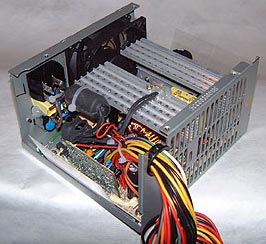 Power Factor Correction (PFC) - In a conventional power
supply with switching regulators, a rectifying circuit that converts AC
input source into a DC source for the primary circuit is used. In this
rectifying circuit, a capacitor with a large capacitance is used to soften
transient response and reduce ripple so that the switching regulator is
not over-stressed. However, the peak charge of the capacitor becomes
greater with greater capacitance, and this leads to non-linear bursts of
peak over current into the primary circuit.
Power Factor Correction (PFC) - In a conventional power
supply with switching regulators, a rectifying circuit that converts AC
input source into a DC source for the primary circuit is used. In this
rectifying circuit, a capacitor with a large capacitance is used to soften
transient response and reduce ripple so that the switching regulator is
not over-stressed. However, the peak charge of the capacitor becomes
greater with greater capacitance, and this leads to non-linear bursts of
peak over current into the primary circuit.