TOP 5 Heat Sinks TOP 5 Low Profile Heat Sinks TOP 5 Liquid Coolers
Heatsinks by Brand / Mfgr Reviews + Articless Advanced Search
|
TOP 5 Heat Sinks TOP 5 Low Profile Heat Sinks TOP 5 Liquid Coolers Heatsinks by Brand / Mfgr Reviews + Articless Advanced Search |
Alpha Novatech PAL8942 Socket 478 Heatsink Review
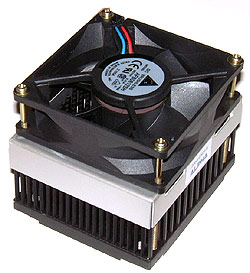
We first came across an Alpha heatsink on Kendon's workshop and later on Akiba PC in 1999 - both Japanese sites are dedicated to all things cooling and computer. Since that first encounter Alpha gained increasing popularity with Slot 1/A overclockers and then sort of faded away after a generally brief flirtation with socket A/370 heatsinks. Then, a few a months ago Alpha came back onto the performance scene with a full-fledged pentium 4 heatsink. Now we have the PAL8942 to mull over and things are looking... decidedly Alpha. Making use of their signature cold-forged aluminum construction with an embedded copper plate the PAL8942 is big, black, and chocked full of hexagonal pins. With an aluminum shroud covering the top 1/3 of the pins an 80mm fan can be attached in either a impingement or exhaust manner for optimal cooling. In fact, we tested the Alpha PAL8942 with the fan in both an exhaust and in an impingement (blowing down) orientation and found that there was indeed a slight performance increase with the fan pulling air up through the fins and expelling it out the top. Previously, we were under the impression (based on tests with older Alpha heatsinks) that facing the fan down offered the best performance. The temperature differences were on the order of a degree or two for the most part.
We were curious about what goes into the making
of an Alpha, whether or not software like Flotherm is used in the fin
modeling or if the design is purely intuitive, or simply trial and error.
Thermal dynamics is still a relatively complicated science, and with dense
designs like the PAL8942, software modeling solutions can apparently become
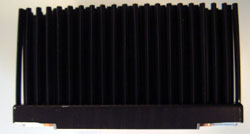
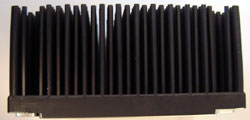
quite cumbersome to rely on. In addition to developing the most efficient heatsink they can, the Alpha designers also have to contend with what can physically be made by the cold forging process. "There are rules as to how dense or sparse a pattern can be. Too sparse, and the tooling may break after several hundred or thousand heat sinks are forged, due to the tremendous pressure. Too dense, and we may not be able to forge it. So, we need to come up with the highest performing pattern that will work within these manufacturing parameters," said Glenn Summerfield the P.D. Manager of Alpha Novatech. In fact, in speaking with Alpha we learned that the PAL8942 was developed from start to finish in just four weeks. Prototypes of the massive socket 478 heatsink were made with different types of pins including; hexagon, octagon, square and dimpled. Obviously, the winning choice was the hexagon shaped pin of which about 530 stick out of the PAL8942. The hexagon pin type is also used on the PAL8045 and PAL6035. A few other tricks went into improving the overall performance of the PAL8942 which we'll get into in just a moment. One of the biggest factors in any heatsinks' performance is undoubtedly the base, and specifically its composition. If too much material is used the base retains heat or doesn't spread it out the fins/pins quickly enough. Too little material in the base and the largest amounts of heat energy is concentrated at the center of the heatsink where air moves less quickly under most fans.
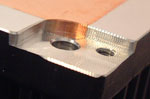
In the case of the PAL8942, the heatsink was first developed with four different combinations of the aluminum base and copper insert before the ideal thickness of ~3.5mm was selected for the final design.
|
 |
|
| |||||||||||||||||||||||||||||||||
|
Find a Heatsink . Latest Heatsink Reviews . Top 5 Heatsinks Tested . Top 5 Low Profile Heatsinks . Top 5 Liquid Coolers . Heatsinks by Mfgr / Brand |
Social Media |
FrostyTech.com Info . Feedback . Contact Us / Heatsink Submissions . Submit News . Privacy Policy |
 | |
© Copyright 1999-2025 www.frostytech.com All Rights Reserved. Privacy policy and Terms of Use Images © FrostyTech.com and may not be reproduced without express written permission. Current students and faculty of accredited Universities may use Frostytech images in research papers and thesis, provided each image is attributed. | ||||